Deep Reinforcement Learning
Temporal Difference Learning & Q-learning
Chair of Safe Autonomous Systems, TU Dortmund
Summer term 2026

Temporal-difference learning and the previous methods
The main aspects of our previous two categories of methods:
- Monte Carlo (MC): learning from experience, possibly without knowledge of a model, e.g., MC prediction with exploring starts: \[Q(s_t,a_t) = Q(s_t,a_t) + \frac{1}{n(s_t,a_t)} \left[g_t - Q(s_t,a_t)\right].\]
- Dynamic programming (DP): bootstrapping \(\Rightarrow\) updating estimates based on estimates, e.g., iterative policy evaluation: \[ \textcolor{red}{V(s)} = \sum_{a\in\Ac} \pias \sum_{s'\in\Sc} \psprimesa \left[ r + \gamma \textcolor{red}{V(s')} \right]. \]
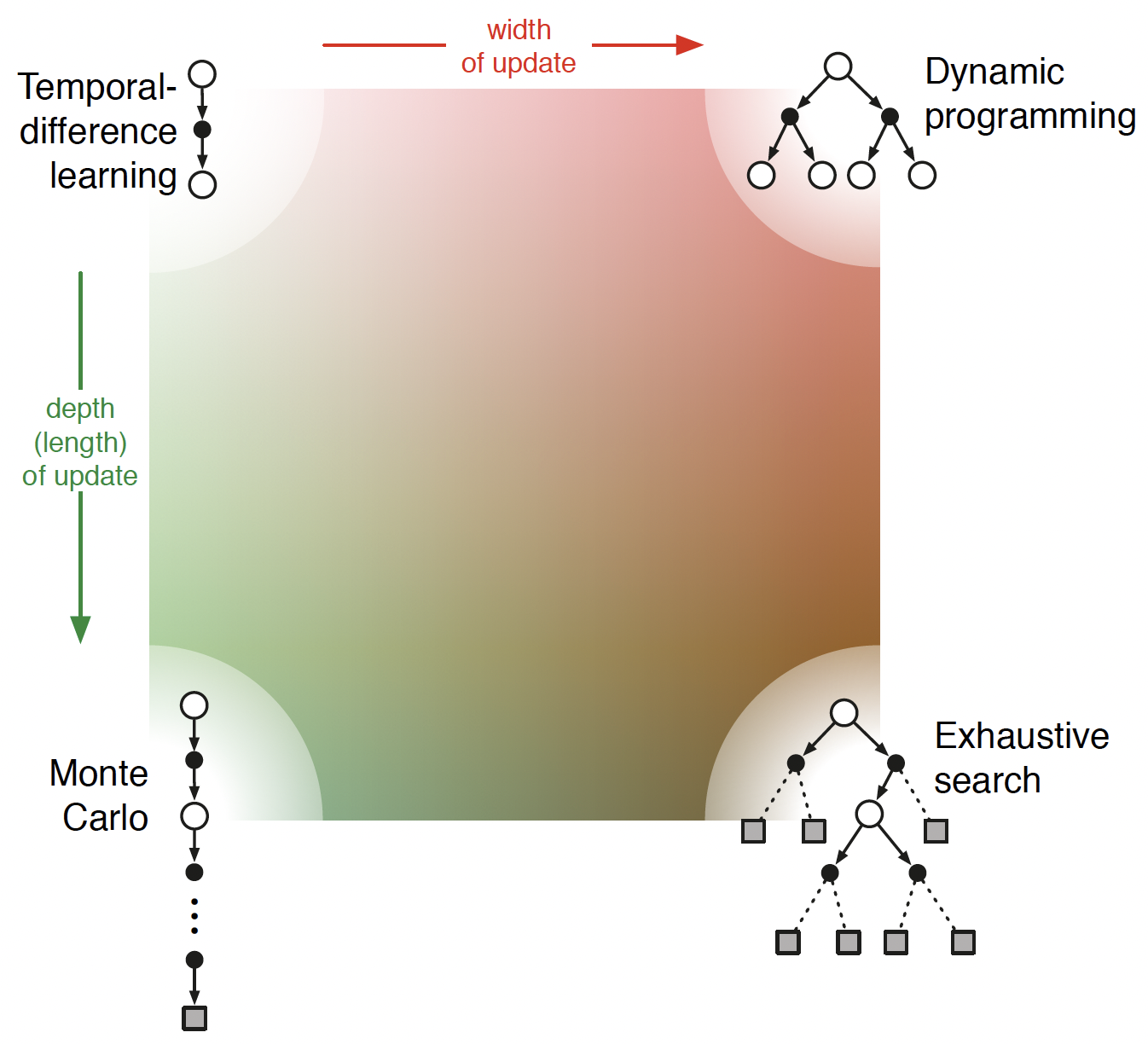
The concept of temporal difference (TD) learning is to combine both:
- Model-free prediction and control in unknown MDPs.
- Updates policy evaluation and improvement in an online fashion (i.e., not per episode) by bootstrapping.
The batch training AB example (1)
Assume that we have an MDP with only two states: \(A\) and \(B\). We do not consider discounting (i.e., \(\gamma=1\)).
We collect eight samples from the dynamics, and we would like to estimate the values \(V(A)\) and \(V(B)\):
| Episode \(k\) | 1 | 2 | 3 | 4 | 5 | 6 | 7 | 8 |
|---|---|---|---|---|---|---|---|---|
| Sequence (\(s,r,s,r\)) | A, 0, B, 0 | B, 1 | B, 1 | B, 1 | B, 1 | B, 1 | B, 1 | B, 0 |
Question: What’s \(V(A)\) and \(V(B)\) based on
- the MC estimate?
- the TD(\(0\)) estimate?
Before approaching this, let’s try to model the underlying MDP!
- \(B\) occurs eight times, follwed by \(r=+1\) in six, and by \(r=0\) in two cases.
\(\Rightarrow\) \(V(B)=\frac{3}{4}\). - What about \(V(A)\)?
- In our example, the only episode containing \(A\) has return \(g=0\) \(~\quad\Rightarrow\) \(V(A)=0\).
- On the other hand, \(A\) is followed by \(r=0\) and then \(s=B\) \(\qquad\quad\Rightarrow\) \(V(A)=V(B)=\frac{3}{4}\).
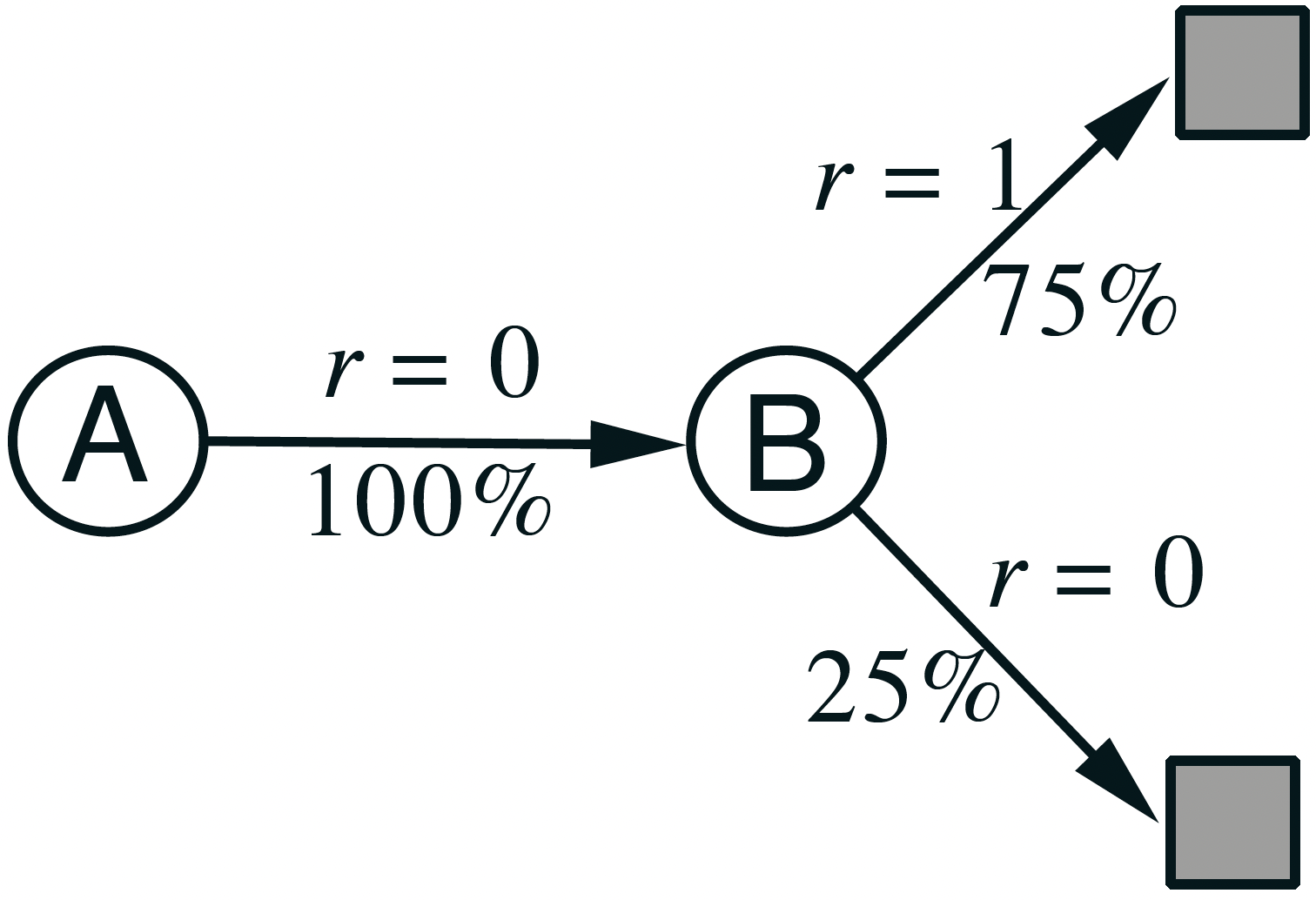
Answer 1. is the MC estimate, answer 2. is the TD estimate!
The random walk example
Consider a simple Markov reward process (MRP; no actions), for which we want to estimate \(V(s)\) from experience only.

- For all states \(s\), we have \(p(\leftarrow) = p(\rightarrow) = 0.5\).
- The MRP is undiscounted (\(\gamma = 1\)).
- The value of each state is the probability of terminating on the right: \(V(A/B/C/D/E) = \frac{1}{6}\) / \(\frac{1}{3}\) / \(\frac{1}{2}\) / \(\frac{2}{3}\) / \(\frac{5}{6}\).
Expected SARSA
What can we do to reduce the large variance in the SARSA update \[Q(s_t,a_t) \gets Q(s_t,a_t) + \alpha \left[r_t + \gamma \textcolor{red}{Q(s_{t+1},a_{t+1})}- Q(s_t,a_t)\right]?\]
Let’s take the expectation of Q \(\rightarrow\) expected SARSA: \[ \begin{align*} Q(s_t,a_t) &\gets Q(s_t,a_t) + \alpha \left[r_t + \gamma \textcolor{blue}{\ExpCsub{Q(s_{t+1},a)}{s_t}{\pi}}- Q(s_t,a_t)\right] \\ &= Q(s_t,a_t) + \alpha \left[r_t + \gamma \left(\sum_{a\in\Ac} \policy{a}{s_{t+1}}Q(s_{t+1},a)\right)- Q(s_t,a_t)\right]. \end{align*} \]
For comparison: \(Q\)-learning \[Q(s_t,a_t) \gets Q(s_t,a_t) + \alpha \left[r_t + \gamma \mathbf{\max_{a\in\Ac} Q(s_{t+1},a)}- Q(s_t,a_t)\right]\]
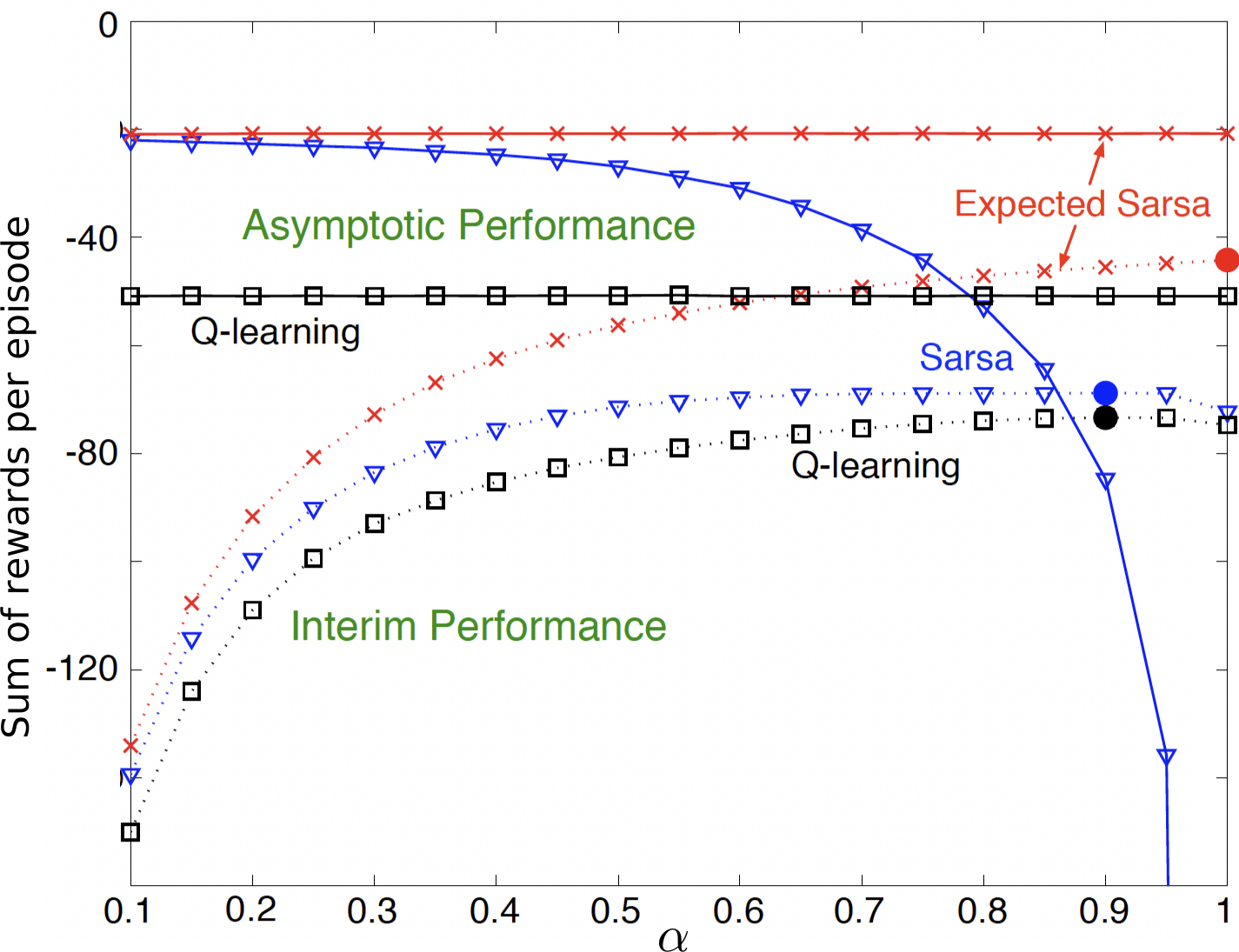
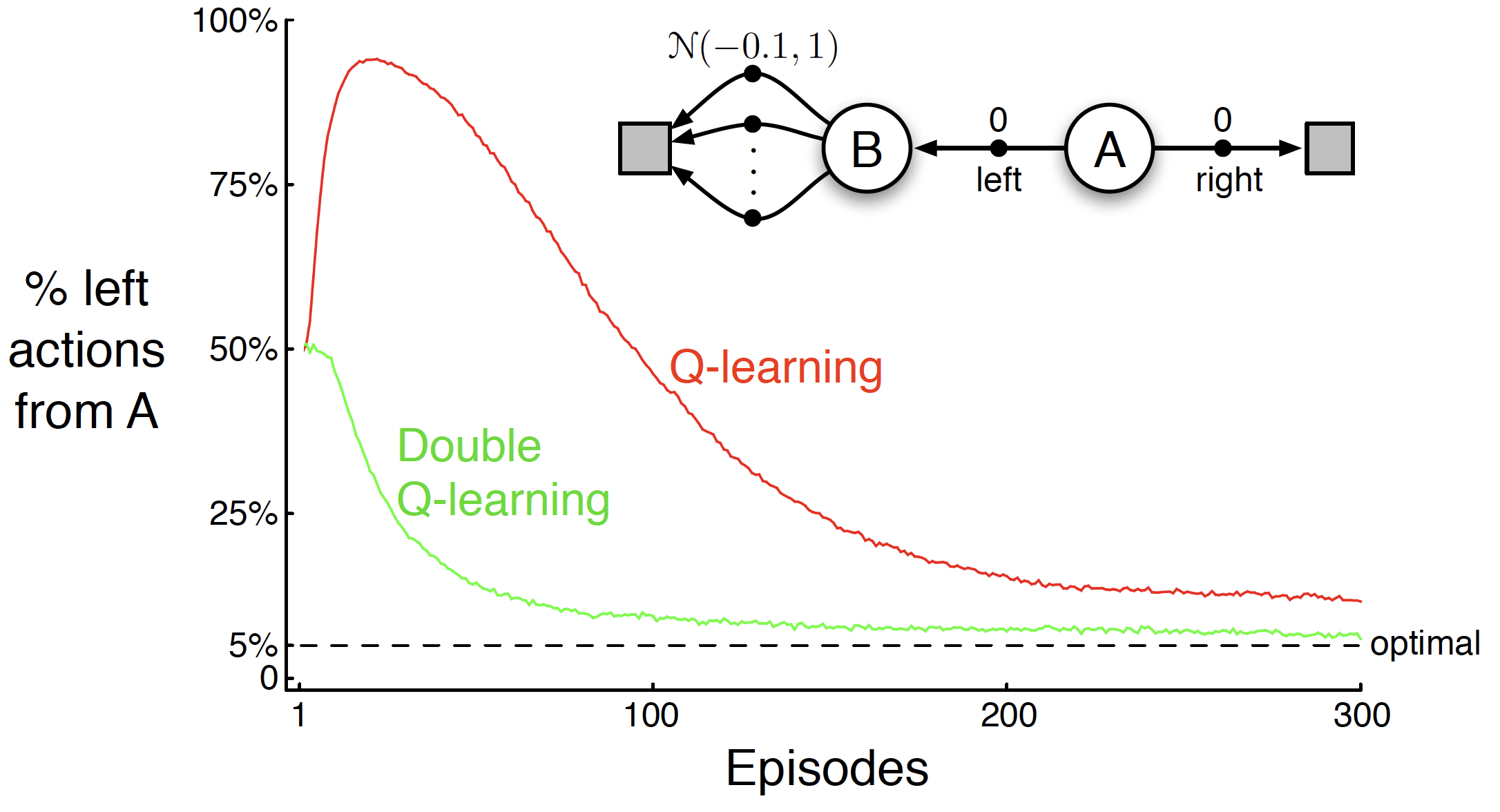
Maximization bias example
Let’s unify MC and TD learning
- MC and TD are the “extreme options” in terms of the update depth.
- What about intermediate solutions?
Example: 19-state random walk

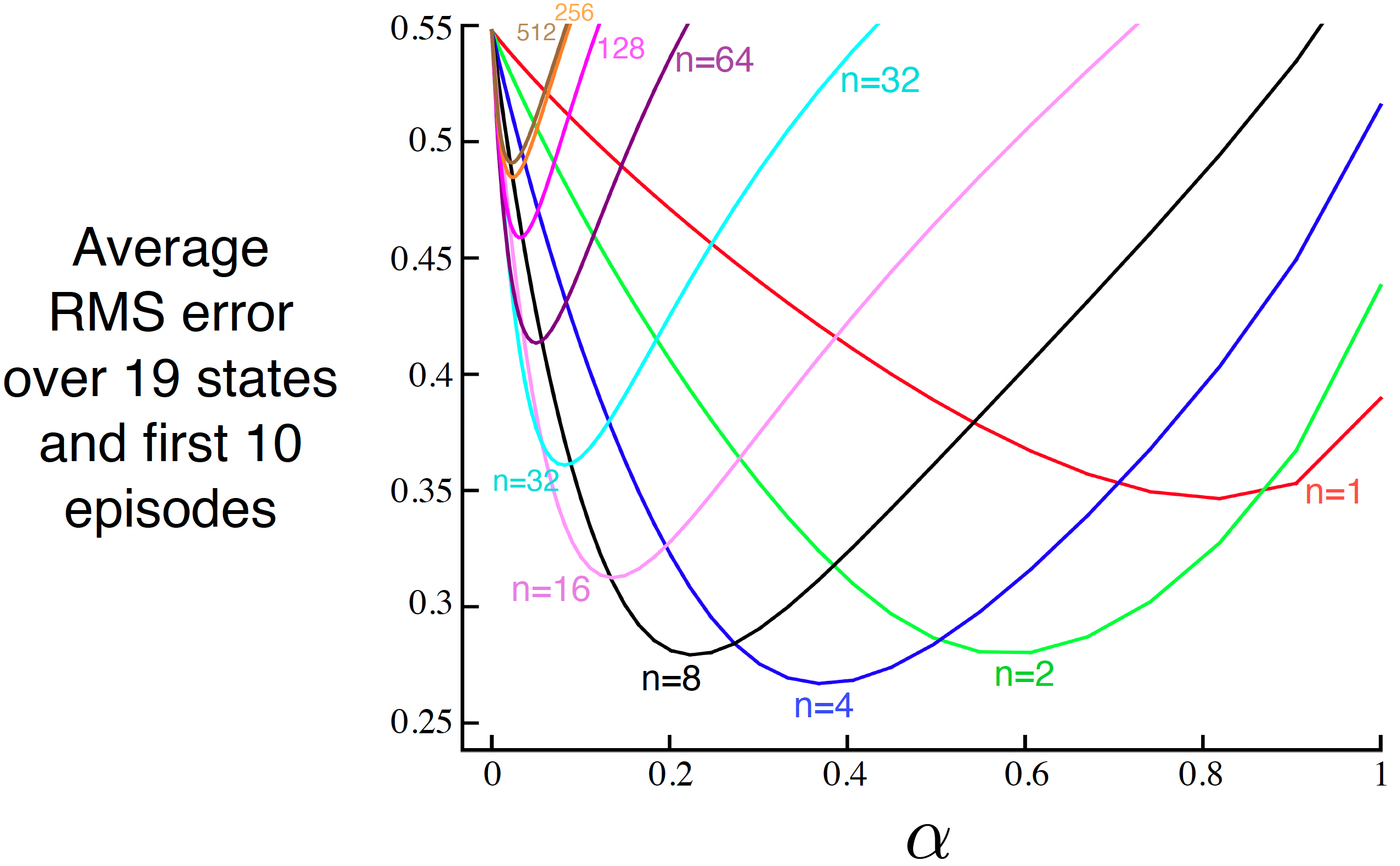
- Early stage performance after only \(10\) episodes
- Averaged over \(100\) independent runs
- Best result here: \(n = 4\), \(\alpha \approx 0.4\)
- Picture may change for longer episodes (no generalizable results)
Averaging of n-step returns
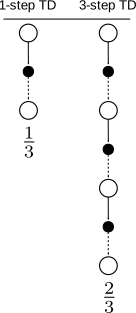
- Averaging different \(n\)-step returns is possible without introducing a bias (if sum of weights is one).
- Example on the left: \[ g = \frac{1}{3} g_{t:t+1} + \frac{2}{3} g_{t:t+3}. \]
- Horizontal line in backup diagram indicates the averaging.
- Enables additional degree of freedom to reduce prediction error.
- Such updates are called compound updates.
\(\lambda\)-return (1)
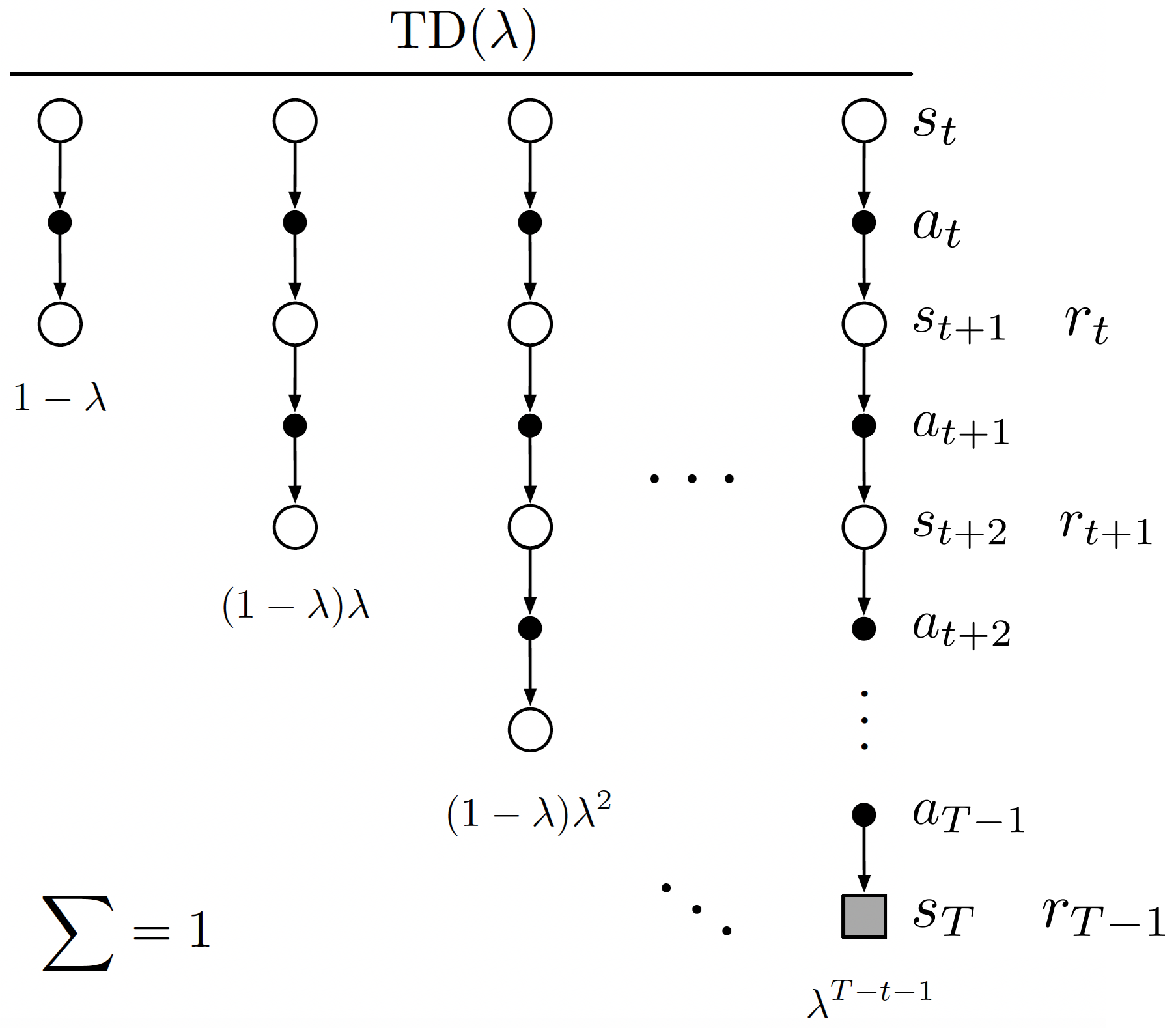
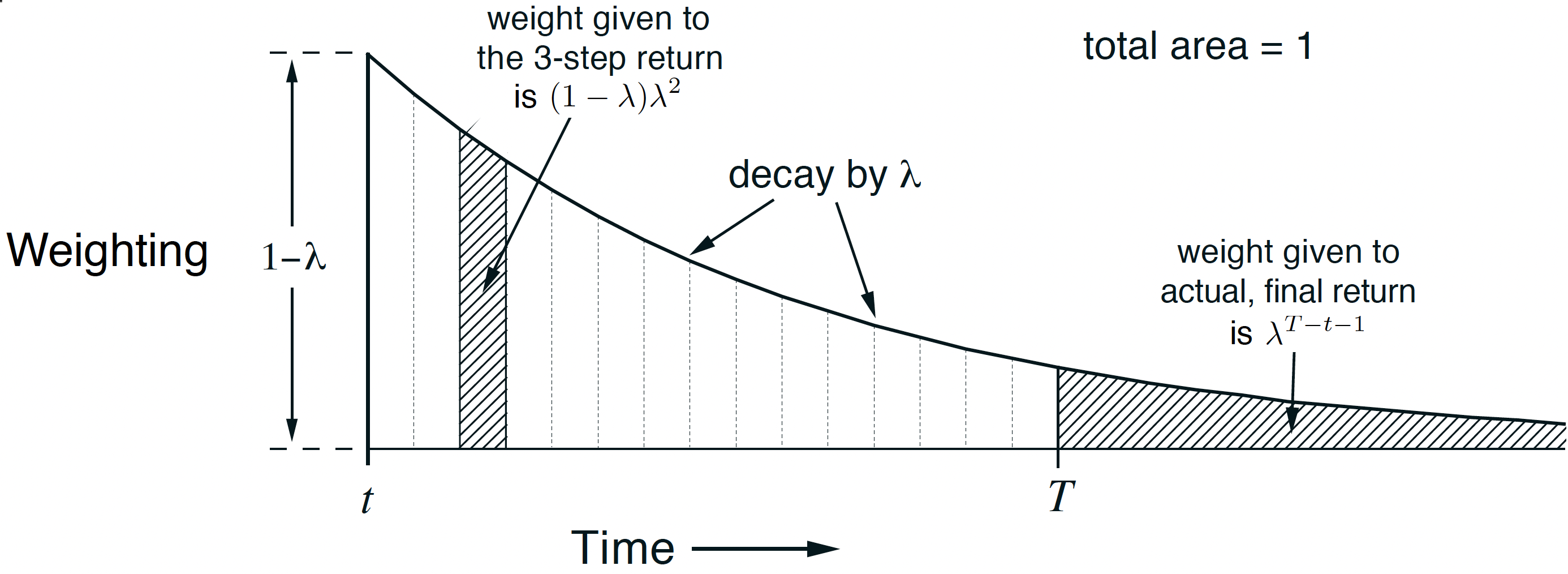
- \(\lambda\)-return: is a compound update with exponentially decaying weights: \[\begin{equation} g_t^\lambda = (1-\lambda) \sum_{k=1}^\infty \lambda^{(k-1)} g_{t:t+n}. \label{eq:TD_infinite-td-lambda} \end{equation}\]
- Parameter is \(\lambda \in [0,1]\).
- Geometric series of weights is one: \[ (1-\lambda) \sum_{k=1}^\infty \lambda^{(k-1)} = 1.\]
\(\lambda\)-return (2)
- Rewrite \(\lambda\)-return for episodic tasks with termination at \(t = T\): \[\begin{equation} g_t^\lambda = (1-\lambda) \left(\sum_{k=1}^{T-t-1} \lambda^{(k-1)} g_{t:t+n}\right) + \lambda^{T-t-1} g_t. \label{eq:TD_finite-td-lambda} \end{equation}\]
- Return \(g_t\) after termination is weighted with residual weight \(\lambda^{T-t-1}\).
- The equation includes two special cases:
- If \(\lambda = 0\): becomes the TD(\(0\)) update.
- If \(\lambda = 1\): becomes the MC update.
Forward view of TD(\(\lambda\))
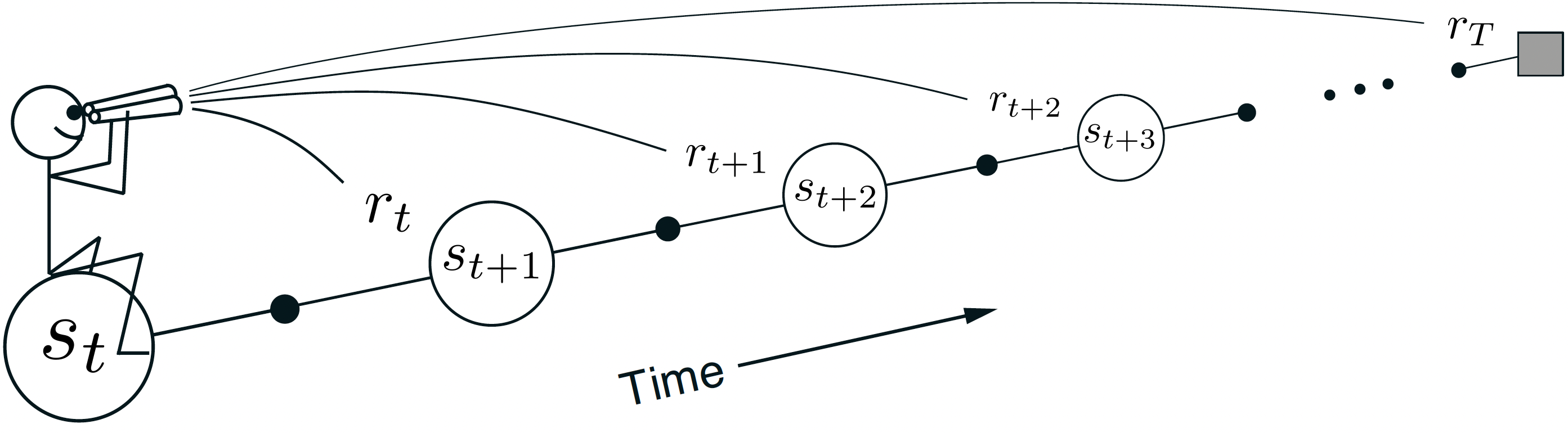
- Both, \(n\)-step and \(λ\)-return updates, are based on a forward view.
- We have to wait for future states and rewards to arrive before we are able to perform an update.
- Currently, \(λ\)-returns are only an alternative to \(n\)-step updates with different weighting options.
Backward view of TD(\(\lambda\))
General idea:
- Use \(λ\)-weighted returns looking into the past.
- Implement this in a recursive fashion to save memory
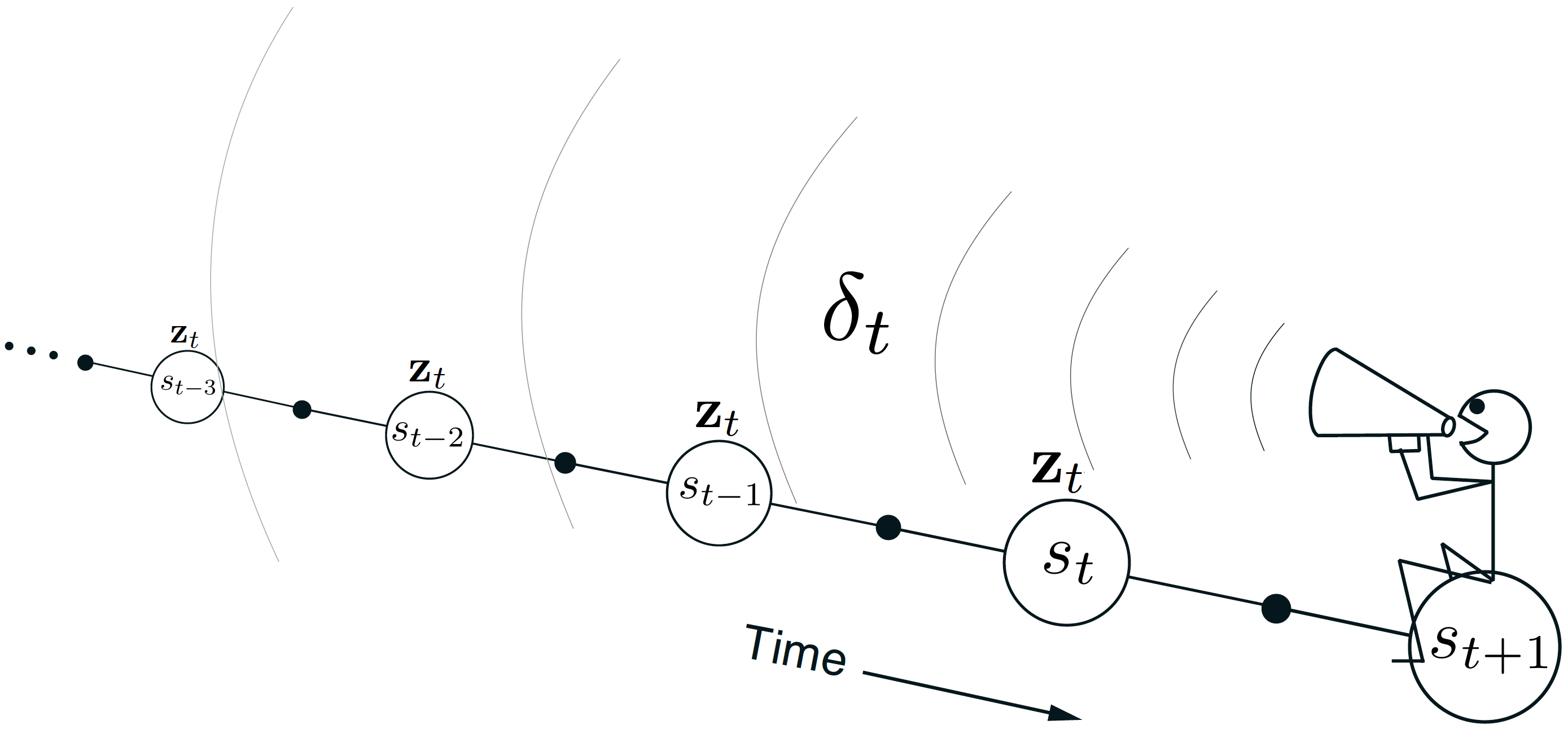
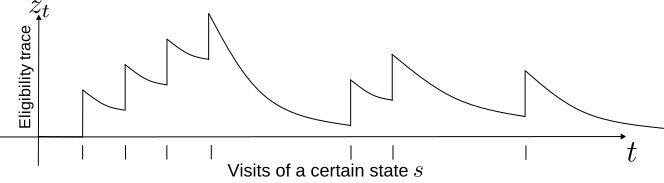
\(\Rightarrow\) Introduce an eligibility trace \(z_t\) denoting the importance of past events to the current state update: \[z_0(s) = 0 \qquad \text{and}\qquad z_t(s) = \gamma\lambda z_{t-1}(s) + \begin{cases} 0 & \text{if}~s_t \neq s \\ 1 & \text{if}~s_t = s \end{cases}.\] - We additionally scale the update term by \(z(s)\), i.e., \(\alpha\cdot[ \target(s) - \mathsf{OldEstimate}(s) ]\textcolor{red}{\cdot z(s)}\). For example, \[ Q(s_t, a_t) \gets Q(s_t, a_t) + \alpha\cdot[ r_t + \gamma Q(s_{t+1}, a_{t+1}) - Q(s_t, a_t) ]\cdot z(s_t, a_t). \]
- Instead of updating only one state-action pair \((s_t,a_t)\) we update along the entire trace we have left.