Deep Reinforcement Learning
Brief Introduction to Deep Learning
Chair of Safe Autonomous Systems, TU Dortmund
Summer term 2026


Bias-variance tradeoff (1)
\(\bullet\) In the ML context, bias denotes the error of the average model \(\overline{f}_{\theta}\) when repeating the training with different datasets \(\Dc_{\mathsf{train},1},\Dc_{\mathsf{train},2},\ldots\): \[ \mathsf{bias} = \Expsub{\left(\overline{f}_{\theta}(x) - f(x)\right)^2}{x\sim\Dtest}. \]
\(\bullet\) variance denotes the variability in between the individual training runs: \[ \mathsf{variance} = \Expsub{\Expsub{\left(f^{(\Dc)}_{\theta}(x) - \overline{f}_{\theta}(x)\right)^2}{\Dc\sim\{\Dc_{\mathsf{train,\ell}}\}_{\ell=1}^\infty}}{x\sim\Dtest}. \]
\(\Rightarrow\) Often a matter of model complexity.
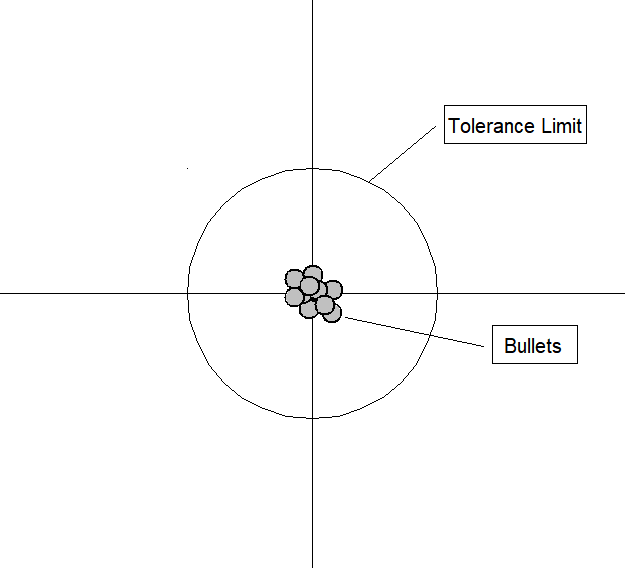 Low bias, low variance
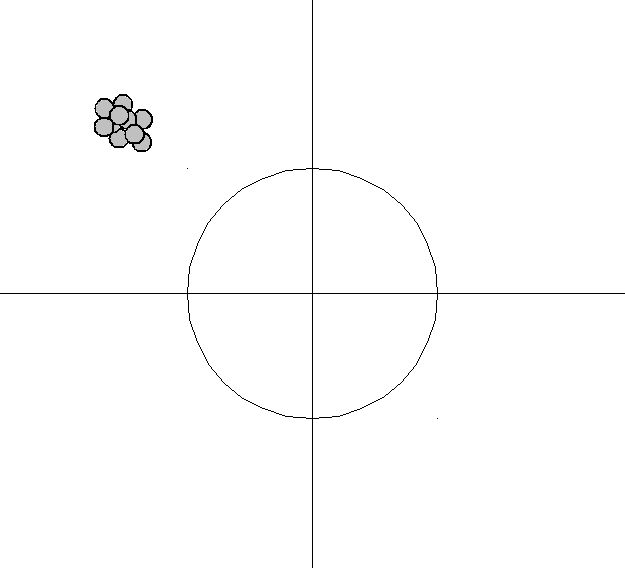 Large bias, low variance
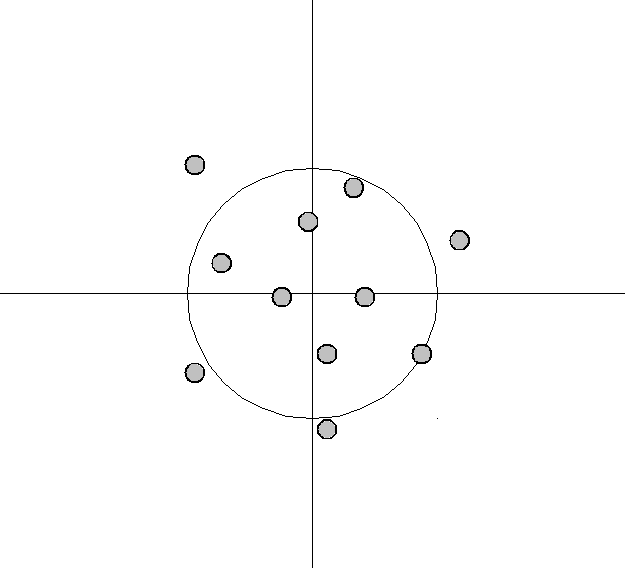 Low bias, large variance
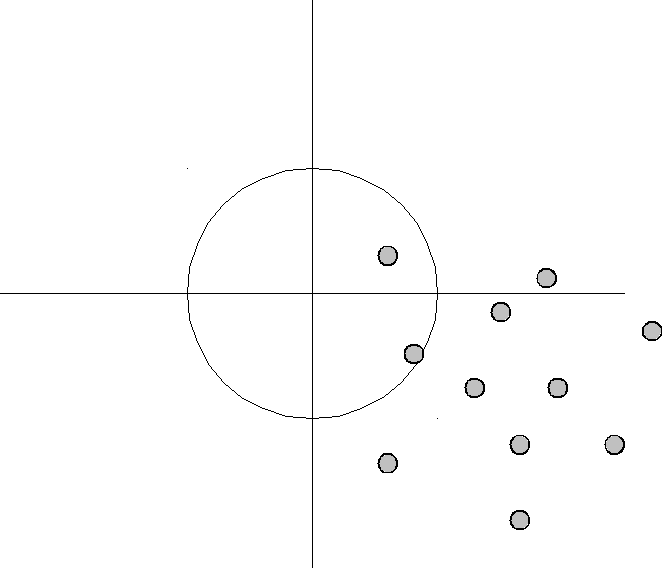 Large bias, large variance [Wikipedia]
Bias-variance tradeoff (2)
Example (see Wikipedia): Fitting a model of serveral radial basis functions to noisy trainig data: \[ f_\theta(x) = \sum_{k=1}^d \theta_k \exp\left(-\frac{1}{2}\frac{x-c_k}{\sigma_k^2}\right). \]
\(\bullet\) For a wide spread (i.e., large \(\sigma_k\)), the bias is high: the RBFs cannot fully approximate the function (especially the central dip), but the variance between different trials is low.
\(\bullet\) As spread decreases (image 3 and 4) the bias decreases: the blue curves more closely approximate the red…
\(\bullet\) … but the variance between trials (\(\Dc_{\mathsf{train,1}},\Dc_{\mathsf{train,2}},\ldots\)) increases.
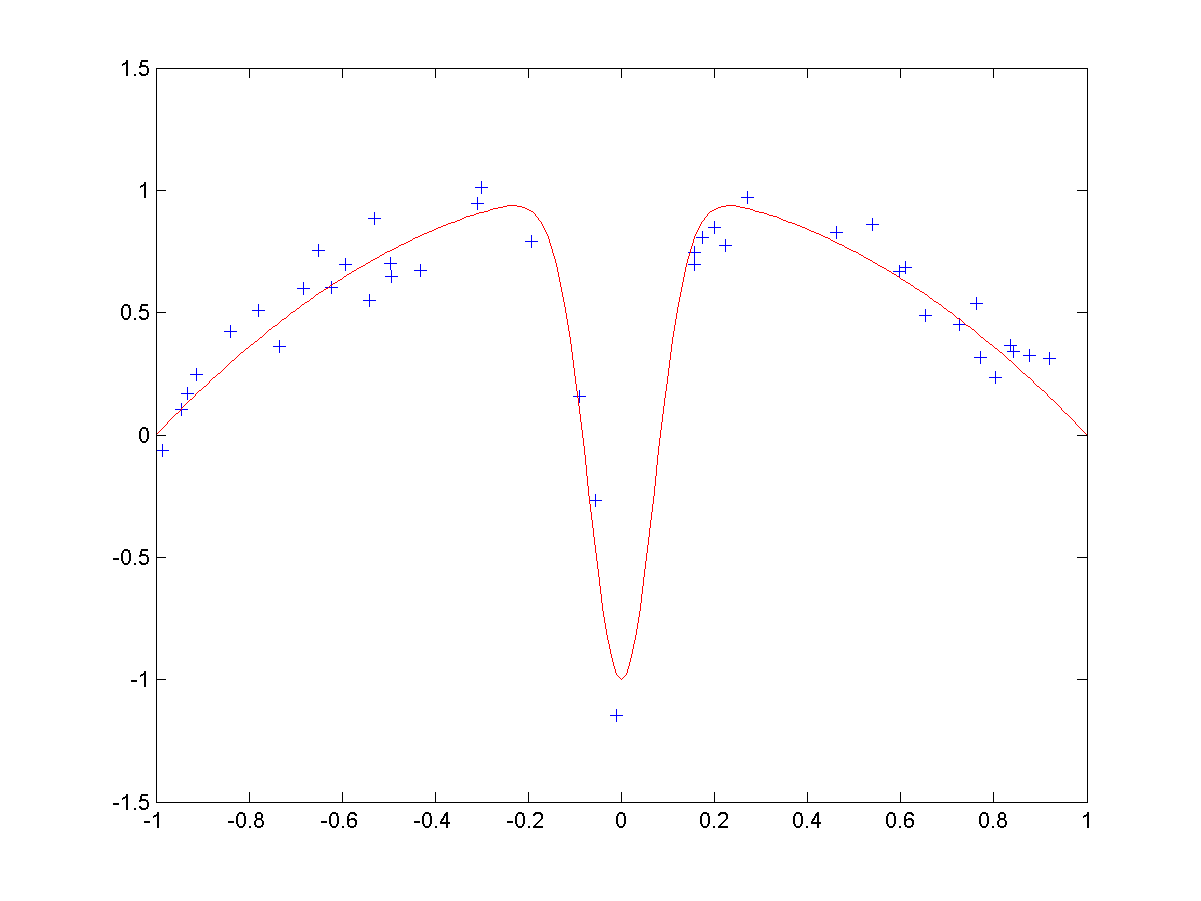
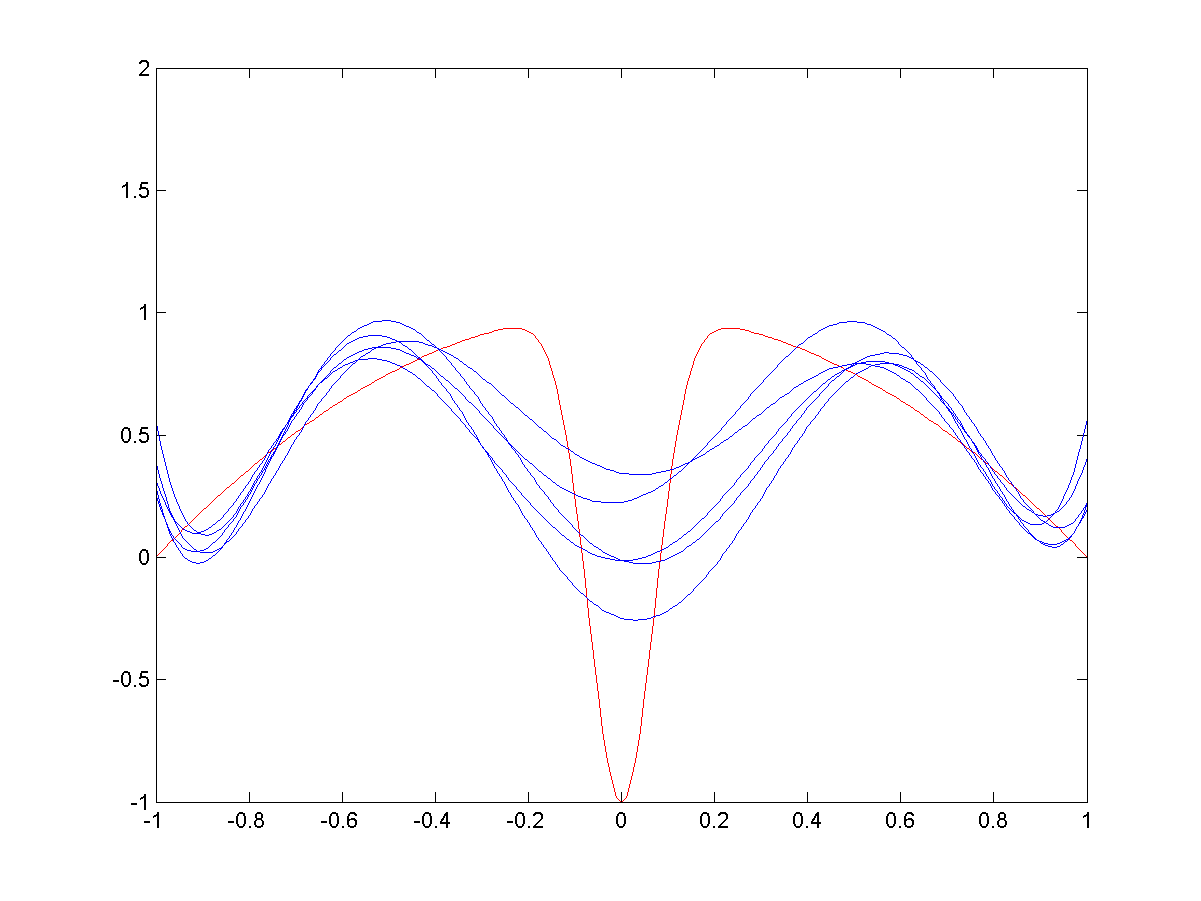 Wide spread RBFs.
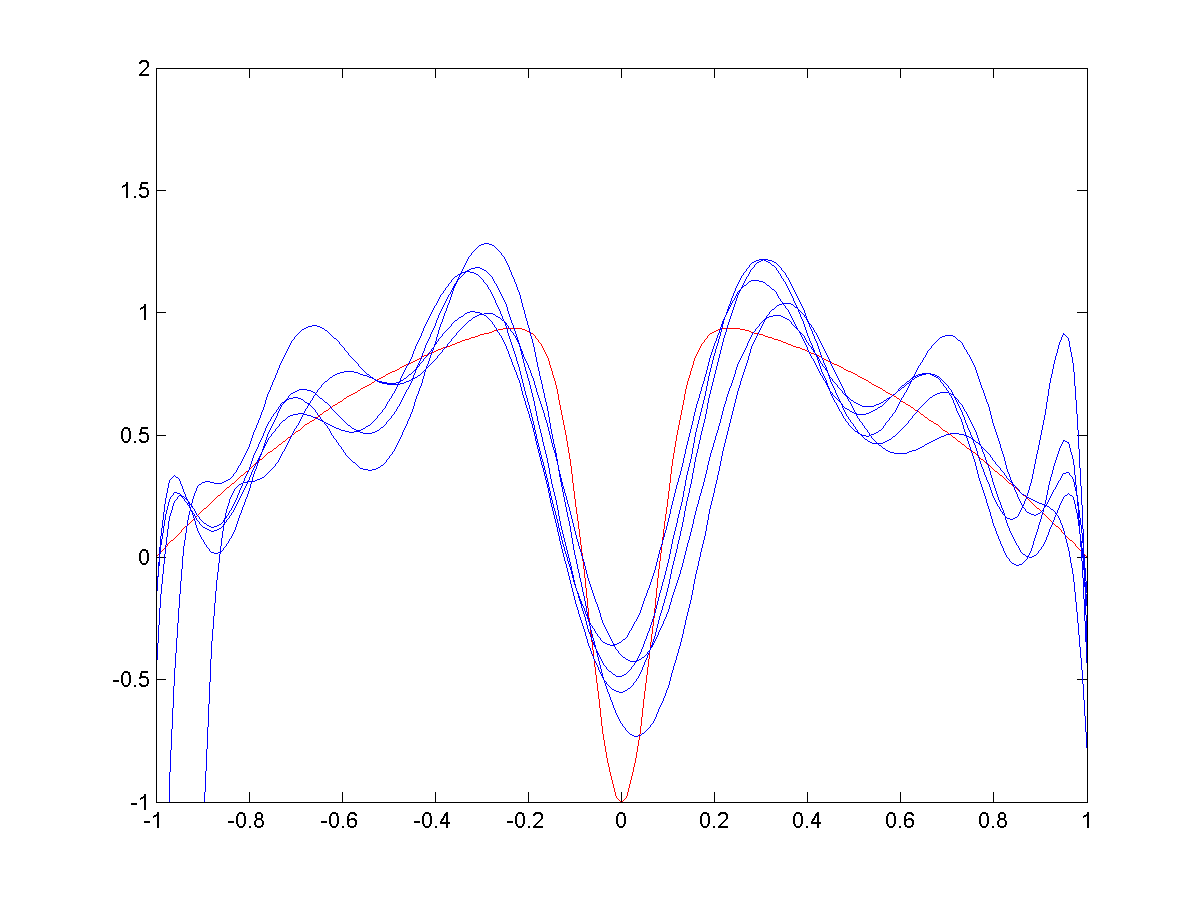 Medium spread RBFs.
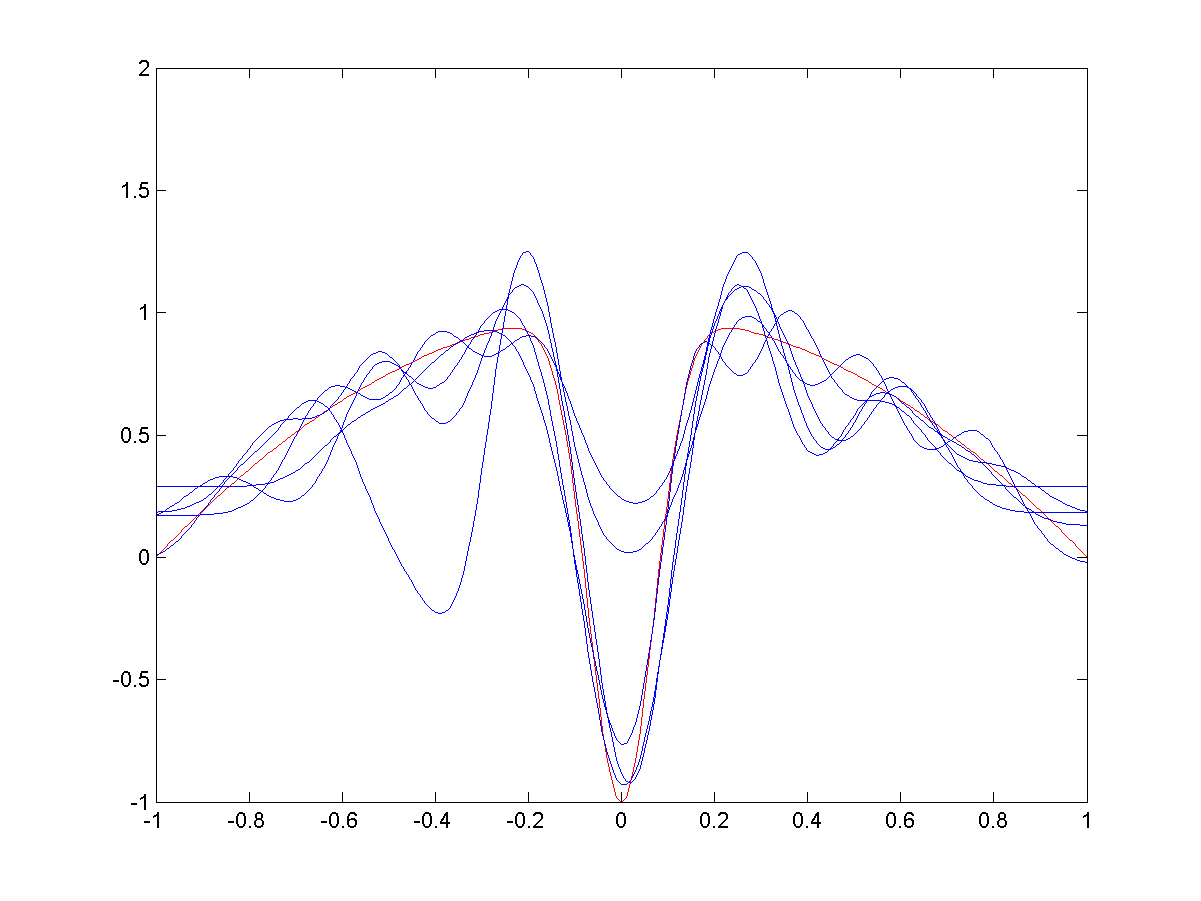 Small spread RBFs.
Cross-validation
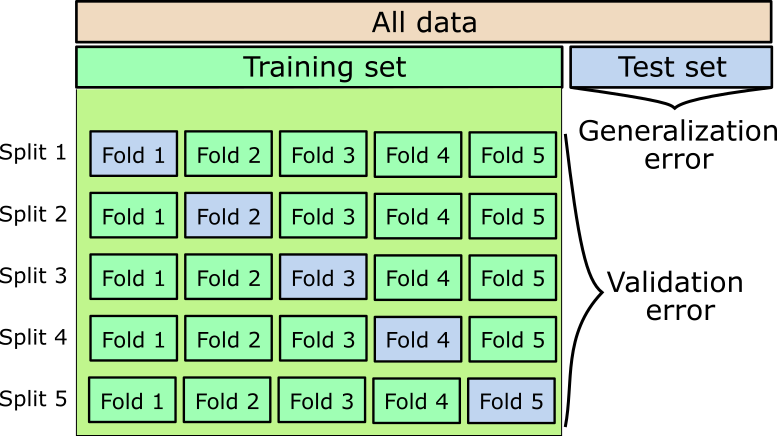
- Training is repeated \(k\) times with \(k\) different splits of the training set.
- Each observation serves as unseen instance (blue boxes) at least once.
- The validation error is an indicator for tuning hyperparameters.
- Example of a \(k\)-fold Cross-validation (CV).
Artificial neural networks
Artificial neural networks (ANNs) are nonlinear function approximators \(\hat{y}=f_\theta(x)\) that
- are end-to-end differentiable.
- are stacks of minimal units, the artificial neurons.
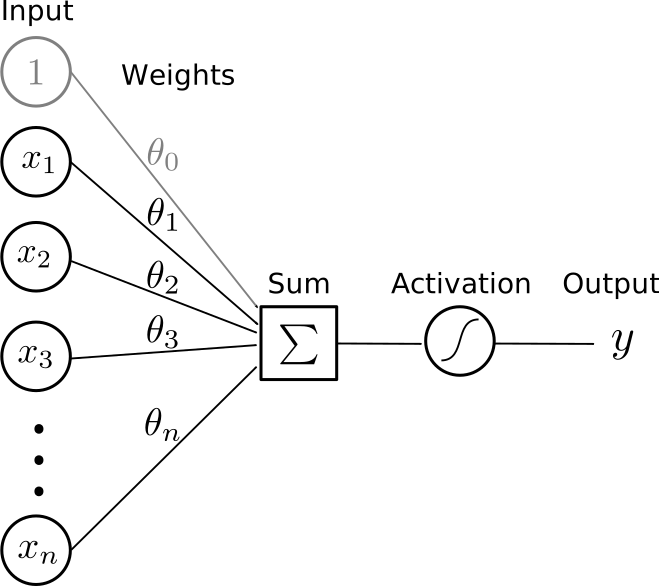
- An ANN consists of nodes or neurons in one or more layers.
- Each node transforms the weighted sum of all previous nodes (plus a potential bias term) through an activation function \(\sigma\): \[ \sigma\left( \theta_0 + \sum_{k=1}^n \theta_k x_k \right). \]
- The weighted connections are called edges, which represent the ANN’s parameters.
Multi-layer perceptron
Standard model of supervised learning: multi-layer perceptron or feed-forward ANN.
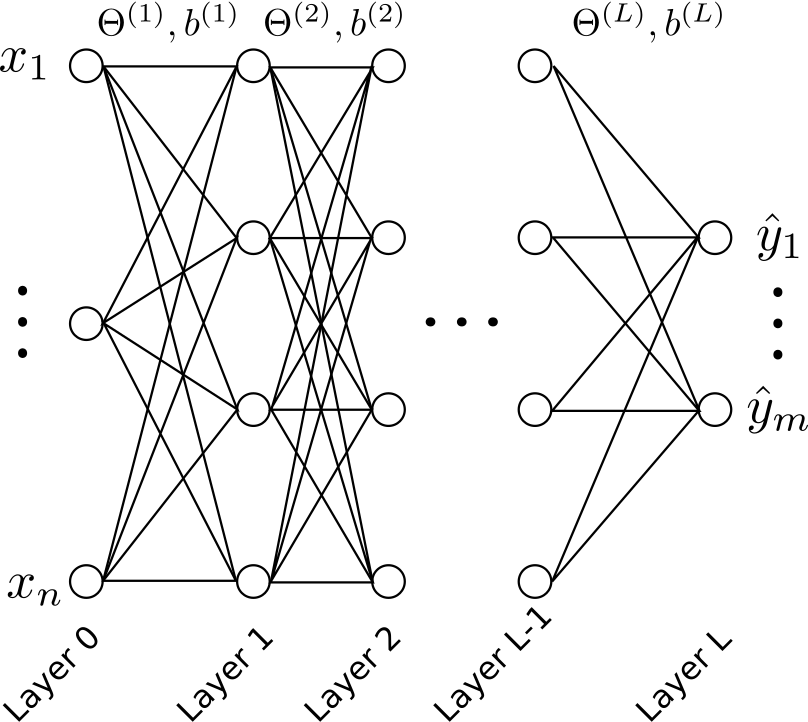
- Only forward-flowing edges.
- The depth \(L\) and width \(\iterate{H}{\ell}\) are hyperparameters.
- With \(\iterate{\sigma}{\ell}\) and \(\iterate{z}{\ell}\) denoting the activation function and activation of layer \(\ell\) respectively, we get for the output in the \(\th{\ell}\) layer. \[ \iterate{x}{\ell}= \iterate{\sigma}{\ell}\big( \underbrace{\iterate{\Theta}{\ell}\iterate{x}{\ell-1} + \iterate{b}{\ell}}_{\iterate{z}{\ell}} \big) ,\] with input \(\iterate{x}{0}=x\) and output \(\iterate{x}{L}=y\):
- Training:
- Summarize the full set of parameters (i.e., weight matrices \(\iterate{\Theta}{\ell}\in\R^{\iterate{H}{\ell} \times \iterate{H}{\ell-1}}\) and biases \(\iterate{b}{\ell}\)) under \(\theta\).
- Iteratively update the weights using gradient information.
Activation functions
- The source of nonlinearity in neural networks.\(^*\)
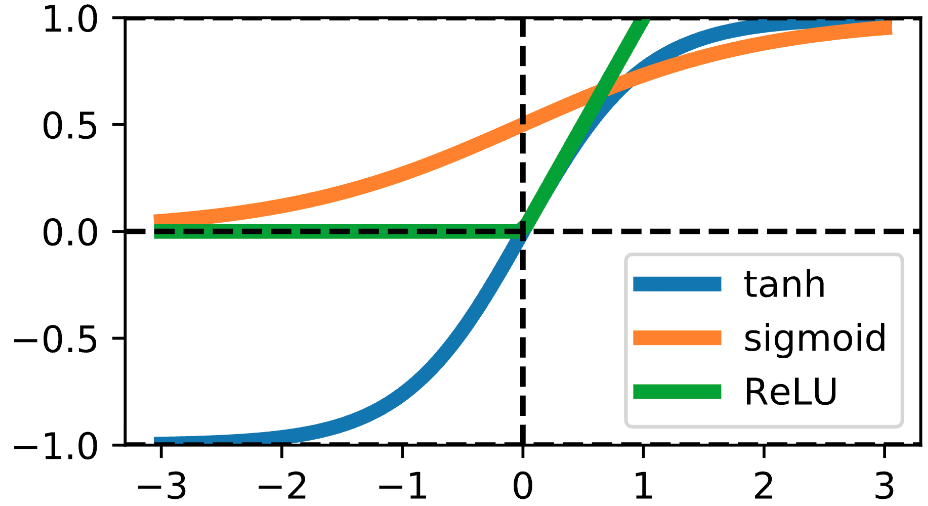
- Common choices for \(\sigma(z)\) are
- \(\sigma(z) = \tanh(z)\),
- Sigmoid: \(\sigma(z) = \frac{1}{1+e^{-z}}\),
- Rectified linear unit (ReLU): \(\sigma(z) = \max(0, z)\),
- The activation of the output layer, \(\iterate{\sigma}{L}(z)\), is task-dependent. For instance,
- regression: \(y=\iterate{\sigma}{L}(\iterate{z}{L})=\iterate{z}{L}\), i.e., \(\iterate{\sigma}{L} = \mathsf{Id}\) is the identity mapping.
- binary classification: sigmoid (i.e., probability), followed by a rounding step to either \(0\) or \(1\).
- multi-class classification: \(y_i=\frac{\exp(\iterate{z}{L}_i)}{\sum_j \exp(\iterate{z}{L}_j)}\) (softmax).
Training (1)
- Training is performed in an iterative manner: \[\theta \gets \theta + \eta \delta\theta.\]
- \(\eta\in\R_{>0}\) is the step size or learning rate.
- \(\delta\theta\in\R^d\) is the update direction, usually a gradient-based descent direction.
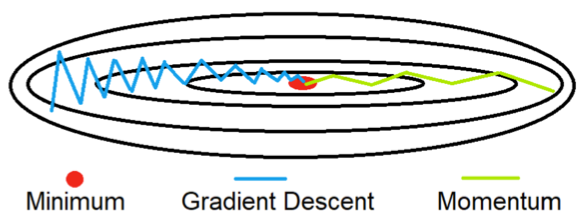
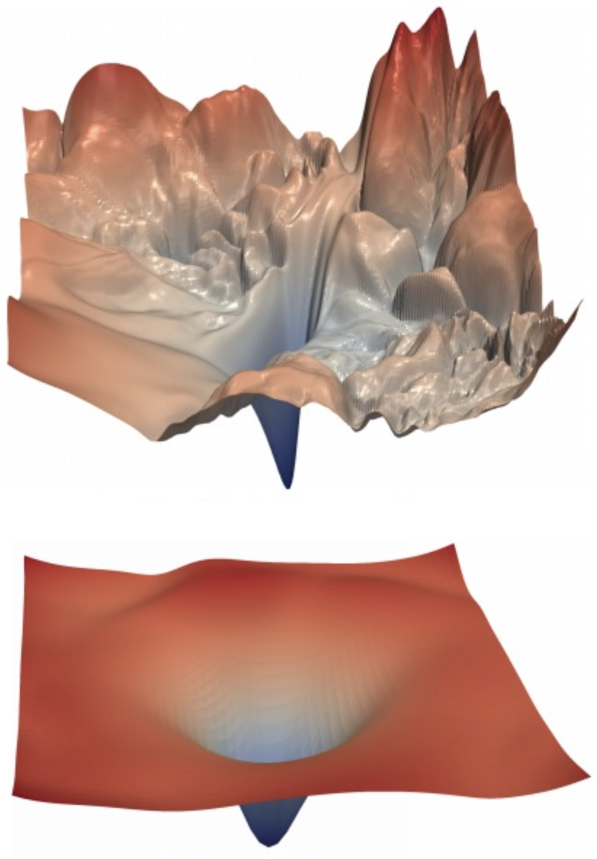
- Numerous variants for \(\delta\theta\). The strongest contain additional momentum terms such as the Adam algorithm (Kingma and Ba 2014). We remember the previous update \(\delta\theta^{-}\) and thereby flatten out zig-zag behavior.
 Source
- First, we need to define a loss function that we wish to minimize.
- Regression: (root) mean square error, mean absolute error.
- Classification: cross entropy.
- Additional terms, e.g., regularization, physics information, …
- Iterations over the dataset \(\Dtrain\) are called epochs.
Stochastic gradient descent and batch learning
- The cost for a single gradient step scales with the dataset size \(N\), which can be very large.
- For each sample, we need to perform one forward and one backward pass.
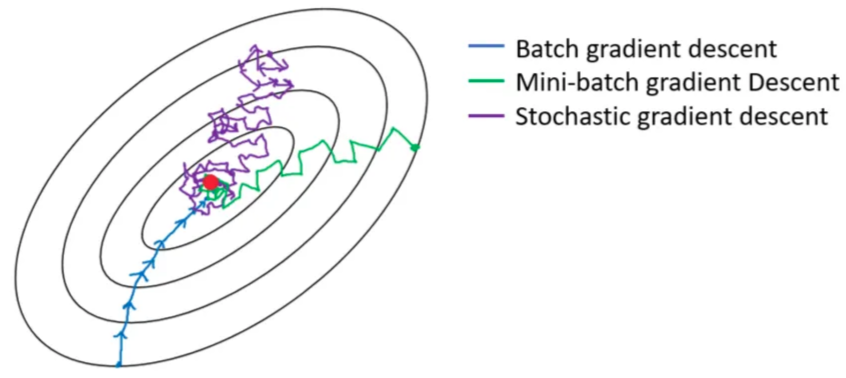
- Stochastic gradient descent (SGD): massive speedup by using a single sample per step insetad of the entire dataset, \[\delta \theta = \nabla L(\theta; x_k), \qquad k\sim U(\{1,\ldots,N\}). \]
- Mini-batch gradient descent with \(s\in\{1,\ldots,N\}\) samples per step: compromise ground between efficiency and noisiness, \[ \delta \theta = \frac{1}{s} \sum_{k\in\mathcal{I}} \nabla L(\theta; x_k), \qquad \text{where}~\mathcal{I}~\text{is an $s$-dimensional, ranodmly drawn subset of $\{1,\ldots,N\}$}.\]
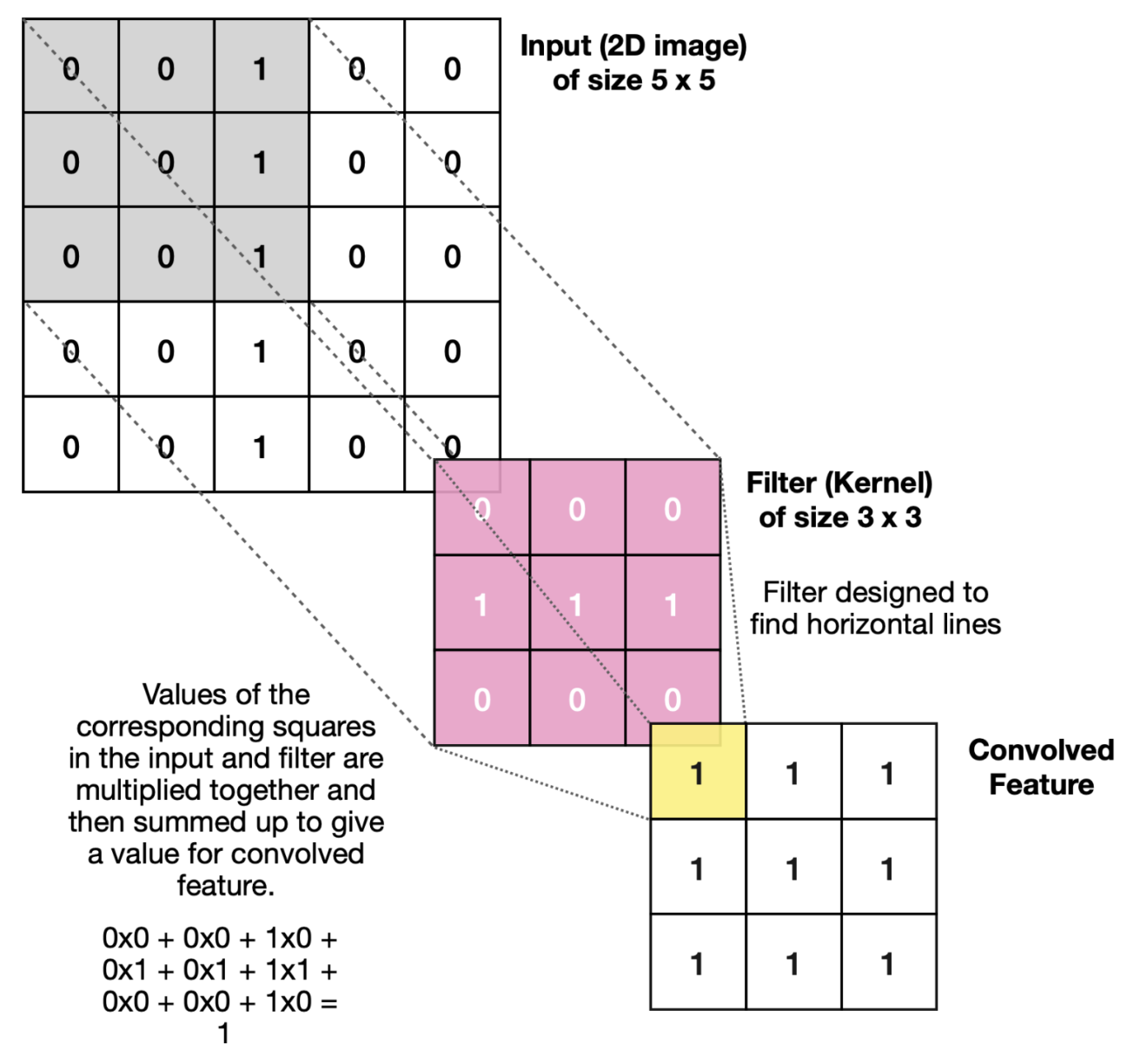
Weight sharing in CNNs
- What does this mean for learning?
\(\Rightarrow\) We have to learn the same thing in different locations!
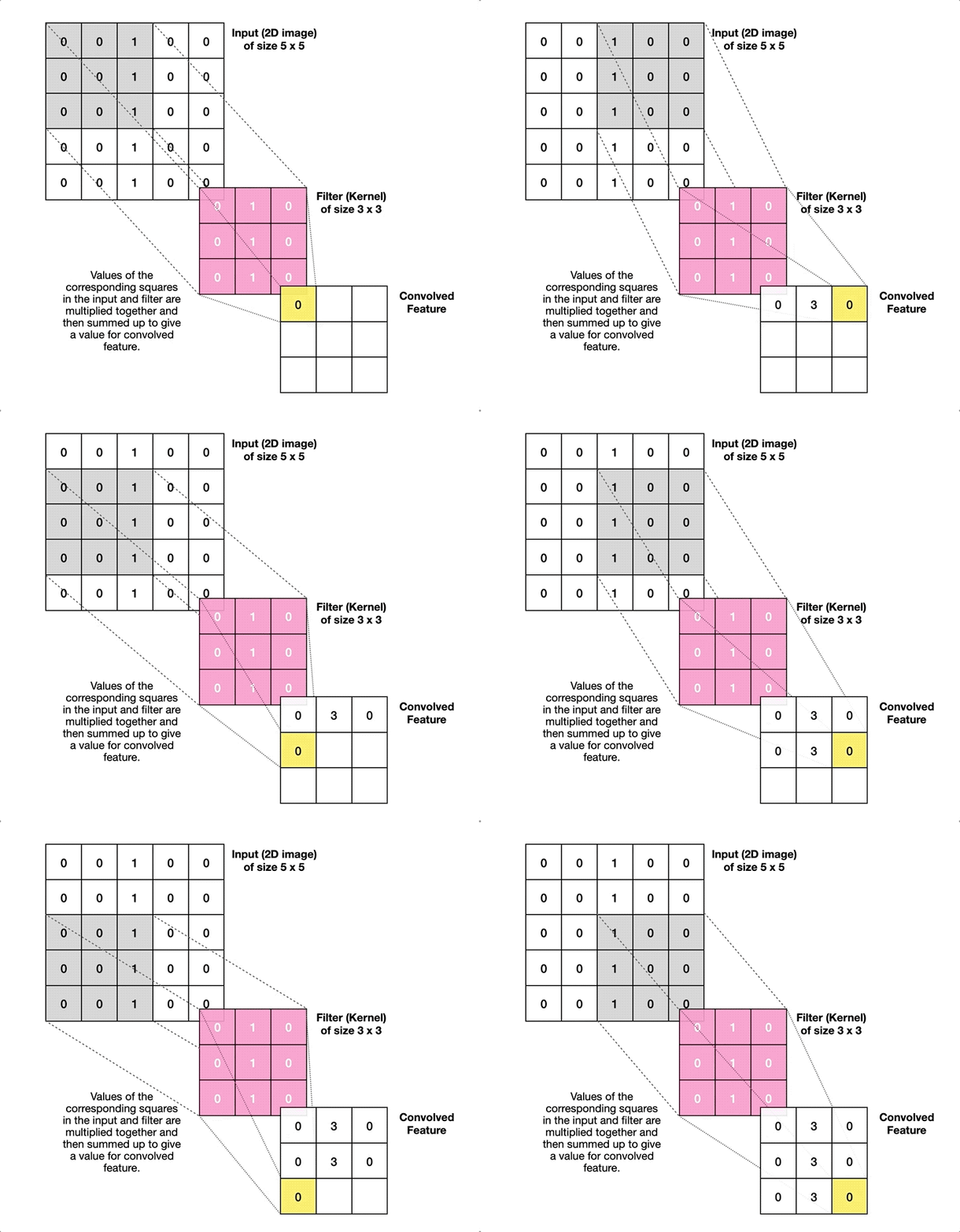
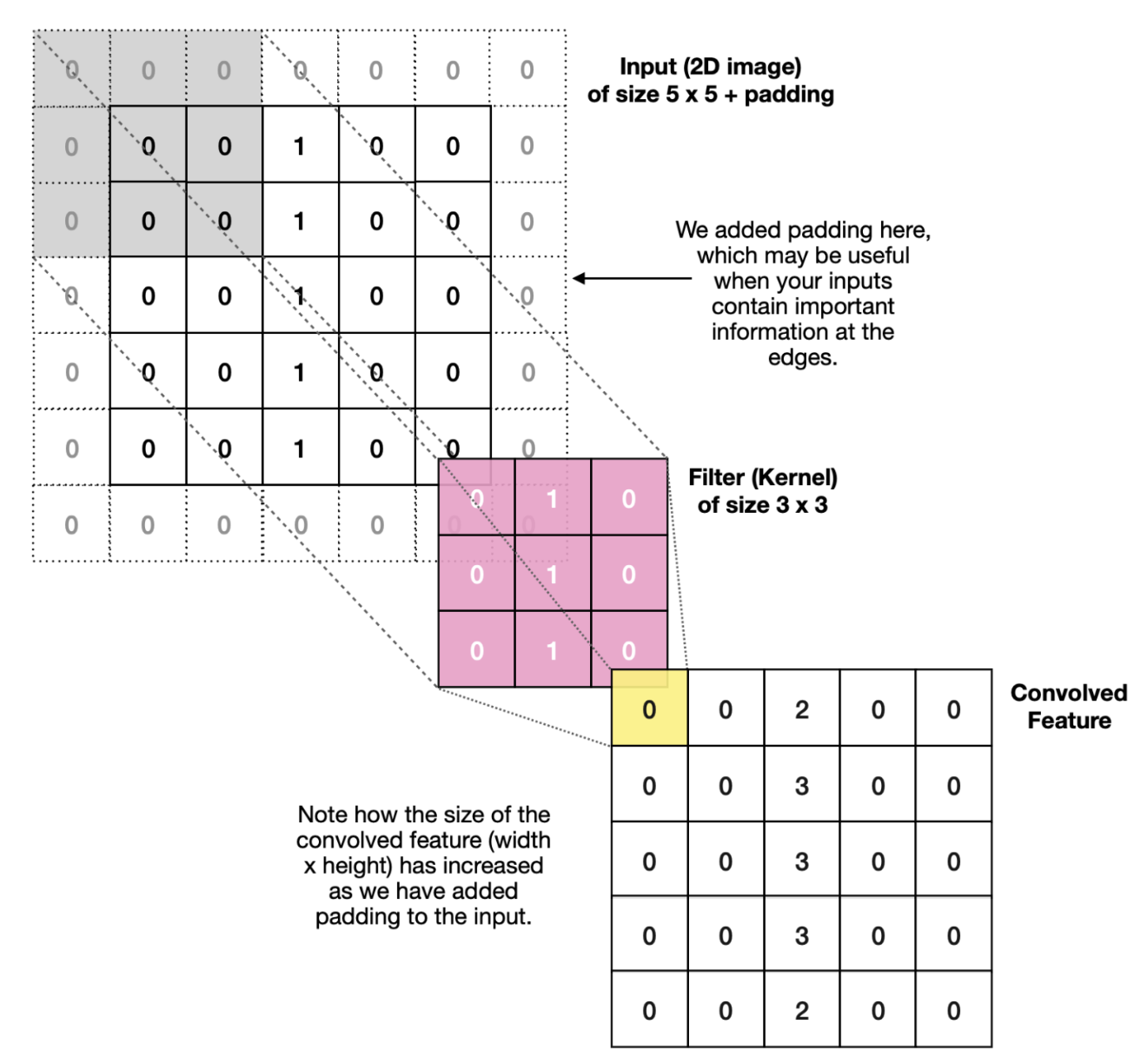
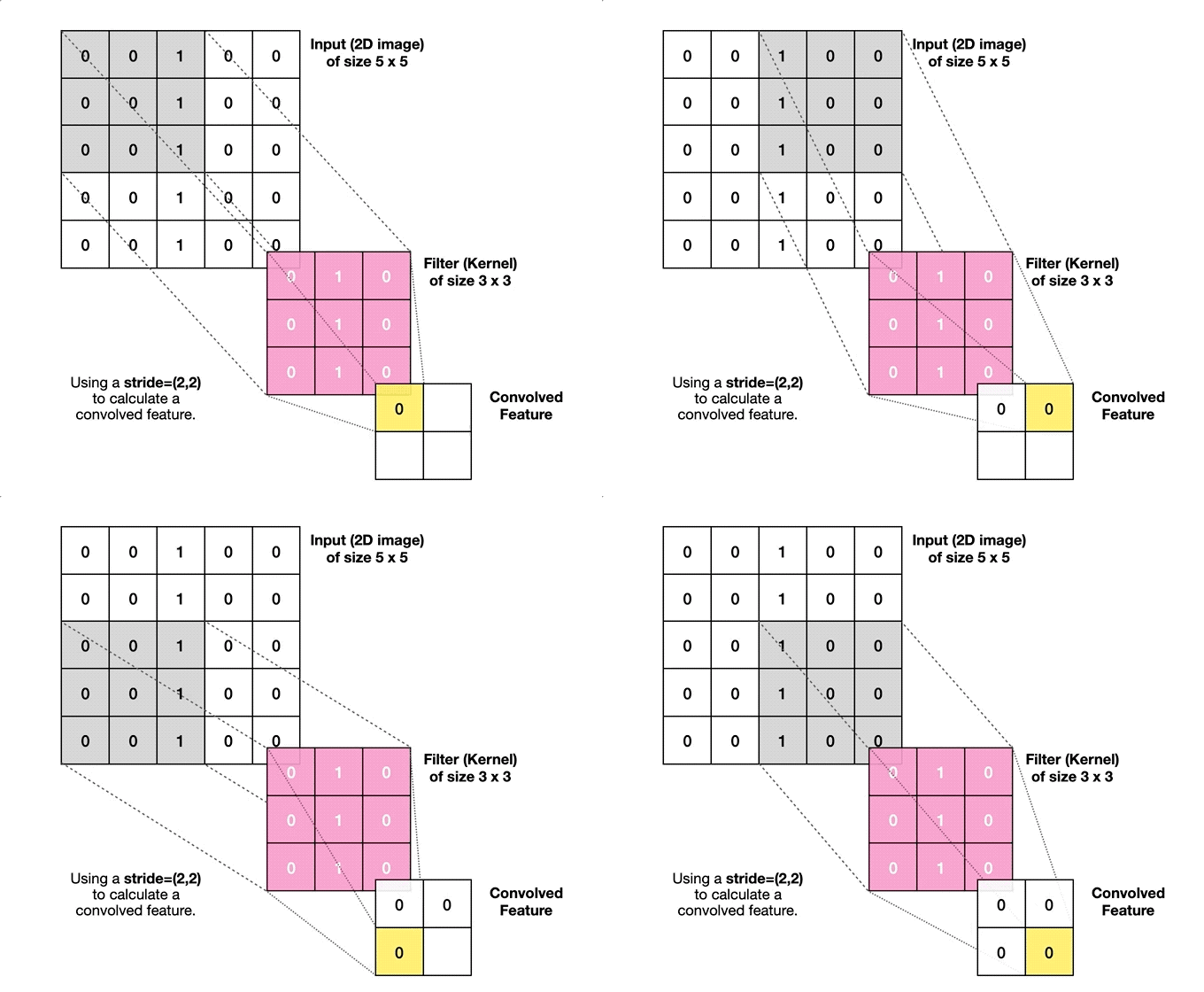
\(\Rightarrow\) An “edge” remains an “edge”, no matter where we are. - Instead of training a fully connected layer, we train the weights of a kernel that moves over the input
- Same weights in every location \(\Rightarrow\) weight sharing!
- Architecture is closely related to fully connected NNs:
- Inner product between kernel weights \(\theta\) and input \(x\) \(\Rightarrow\) activation \(z\).
- Multiple kernels \(\Rightarrow\) multiple channels.
- Then comes a nonlinear activation function \(\sigma(z)\).
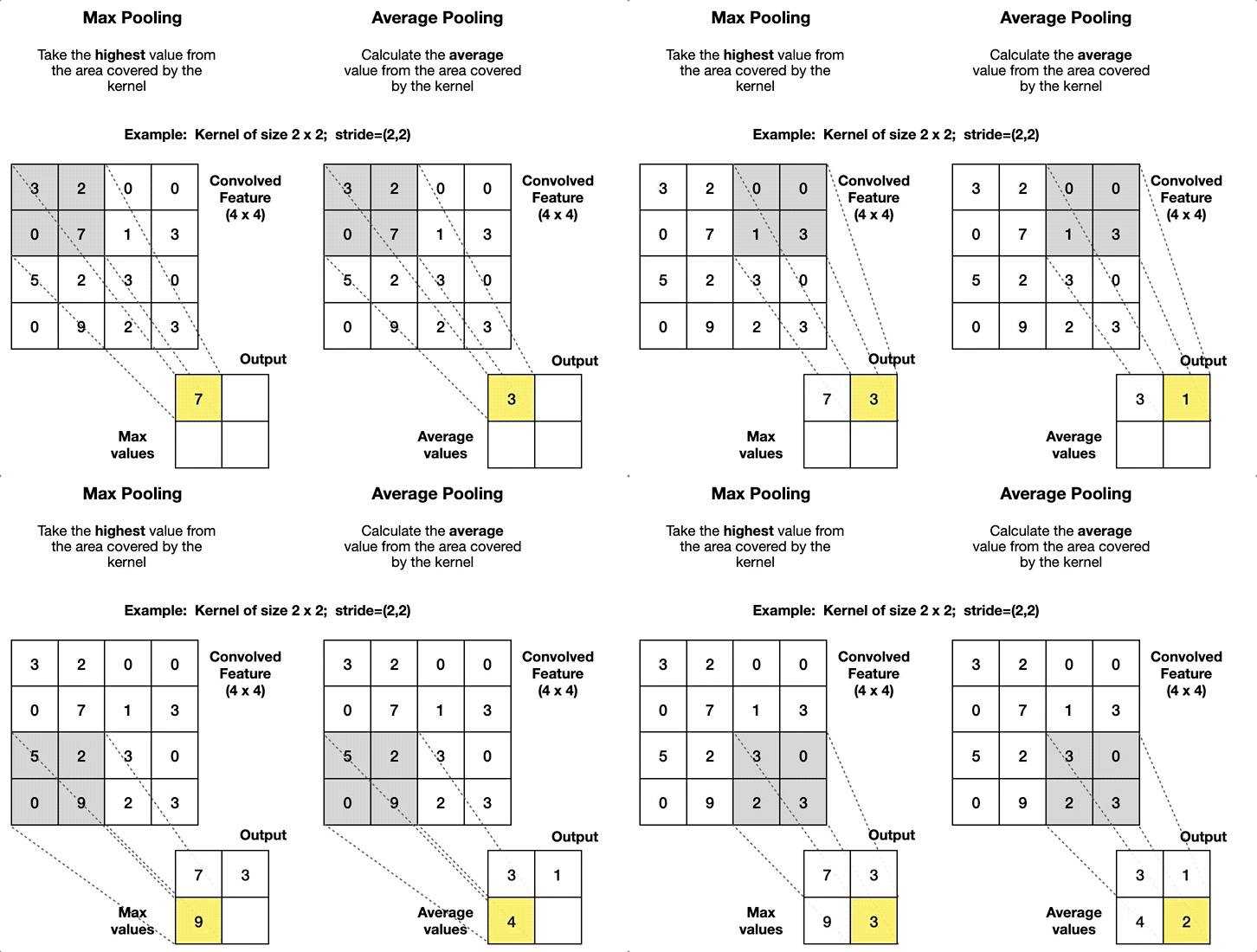
- Further followed by additional steps (see next slide).

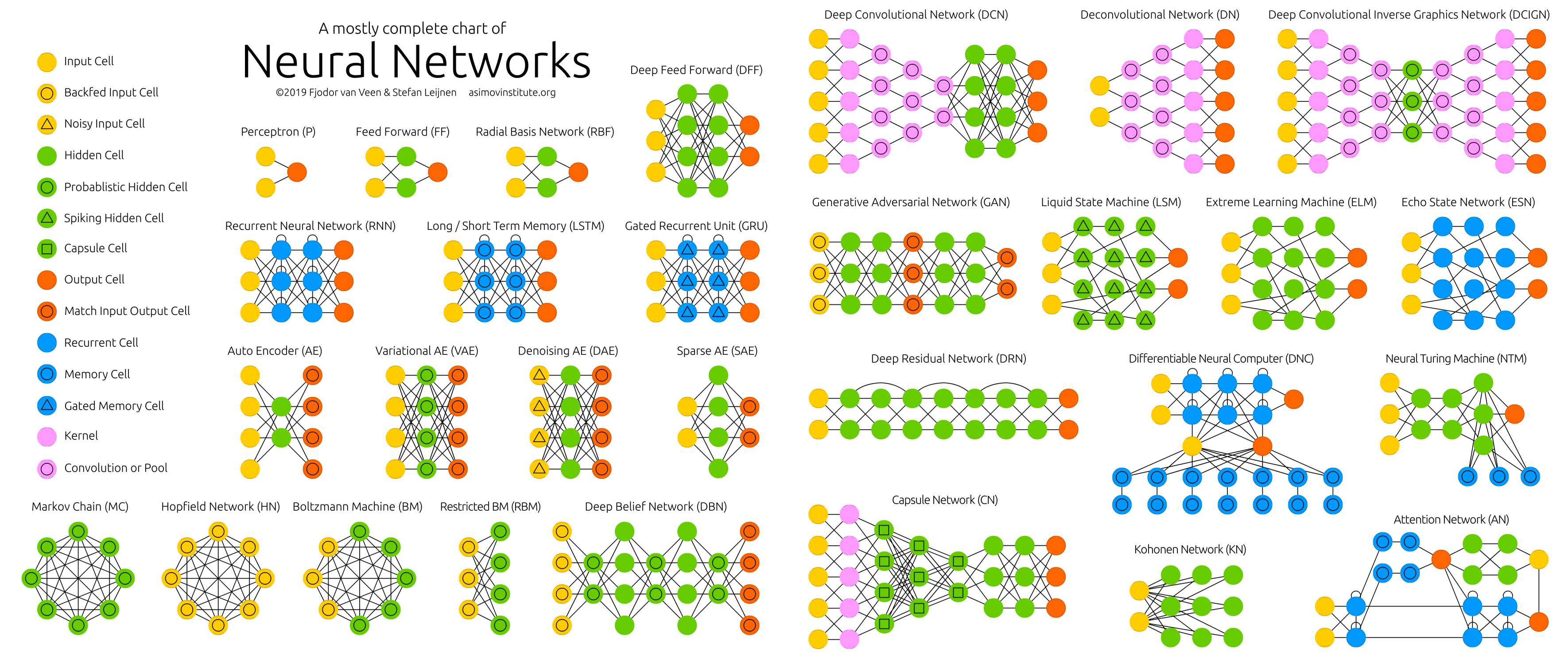
Neural network architectures
Features as an additional pre-processing step
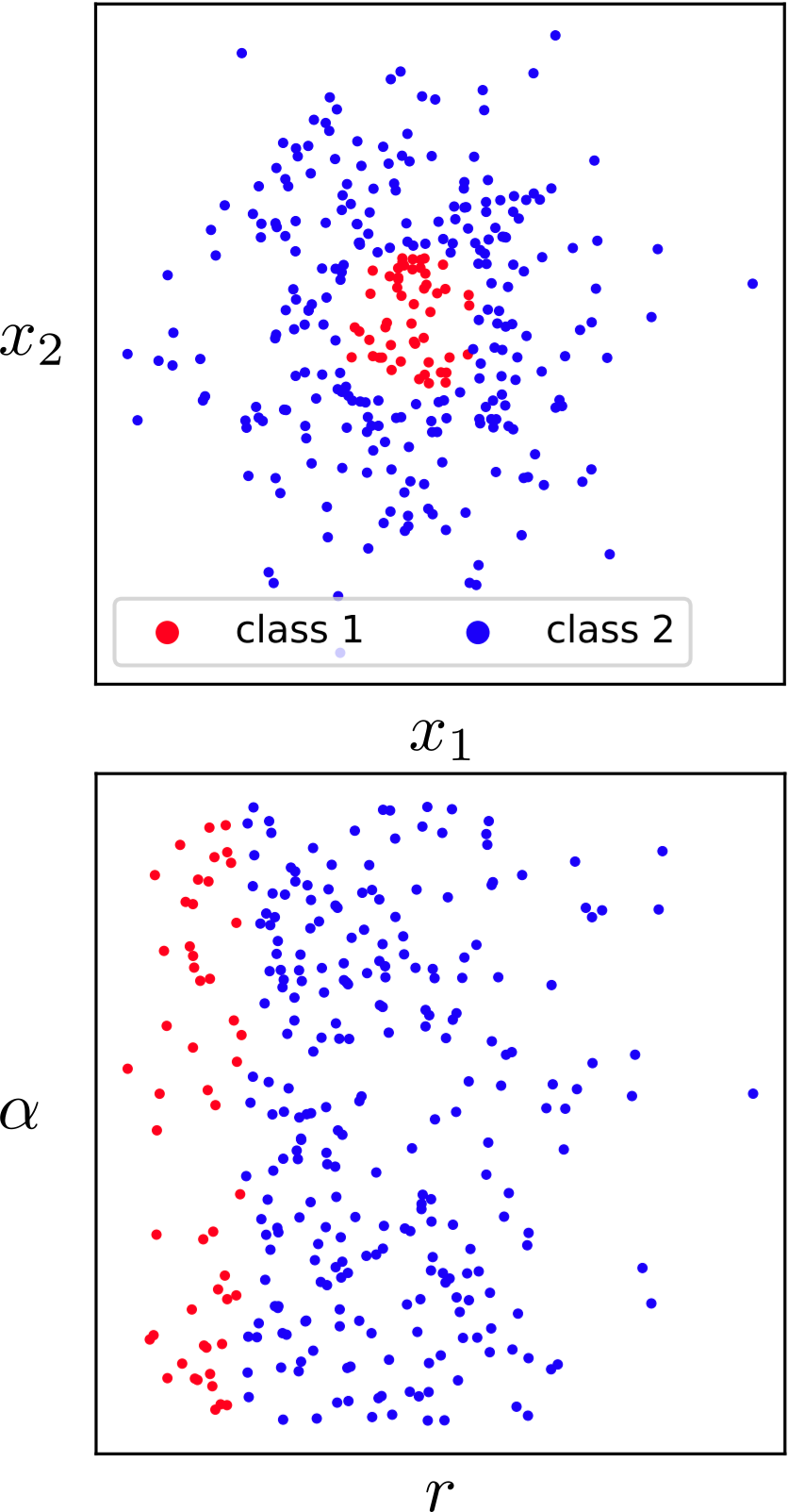
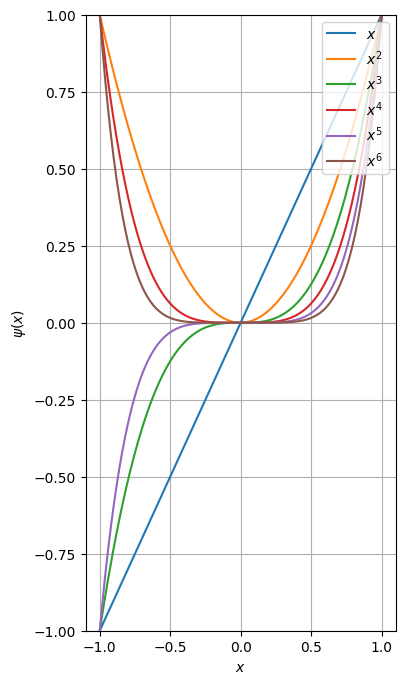
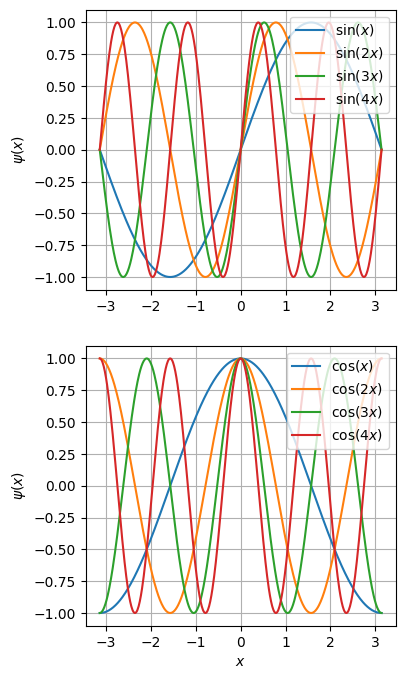
- If we introduce feature functions \(\psi_i:\R^n \rightarrow \R\), \(\psi_i(x) = z_i\), then we can significantly improve the performance: \[ \psi(x) = [\psi_1(x), \ldots, \psi_q(x)]^\top. \]
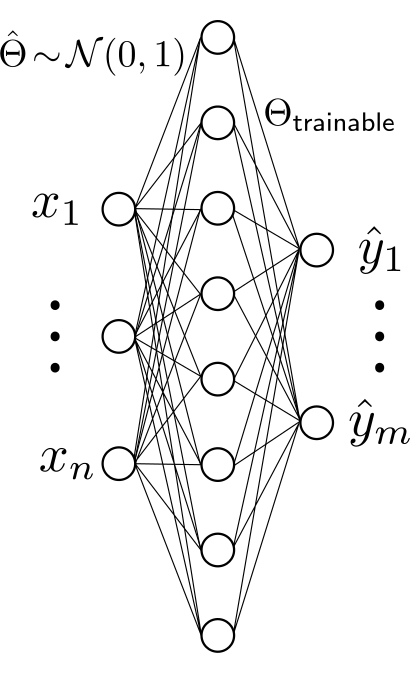
- Different ways of introducing features: