Deep Reinforcement Learning
Deep Q Learning
Chair of Safe Autonomous Systems, TU Dortmund
Summer term 2026


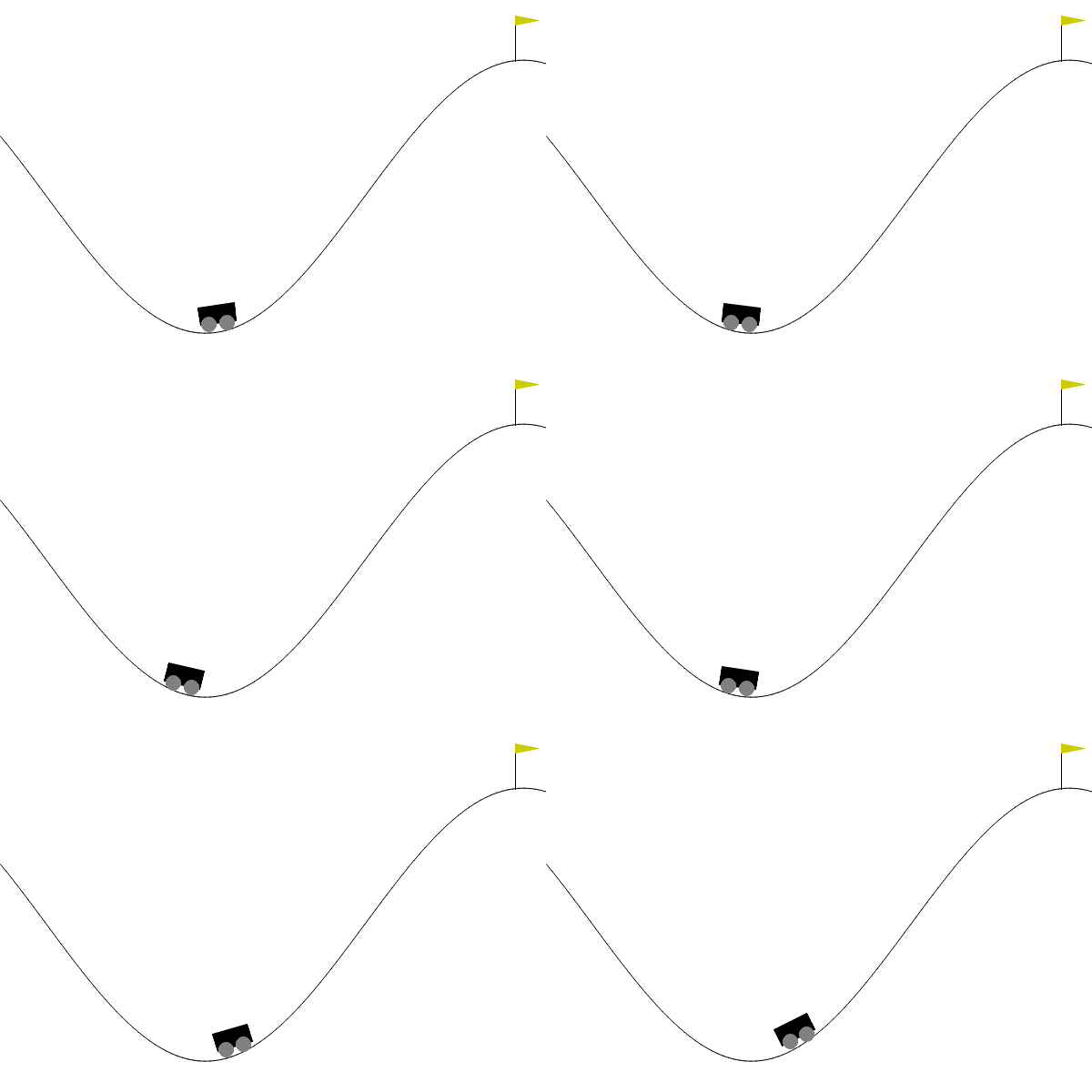
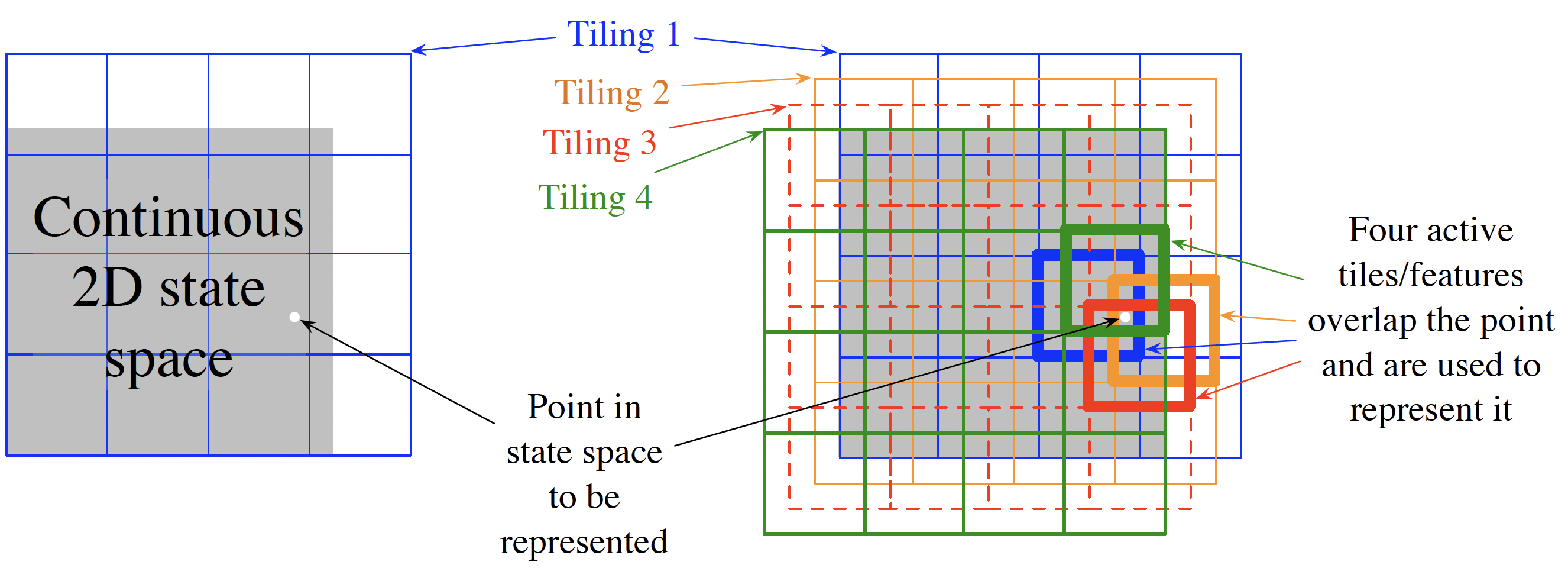
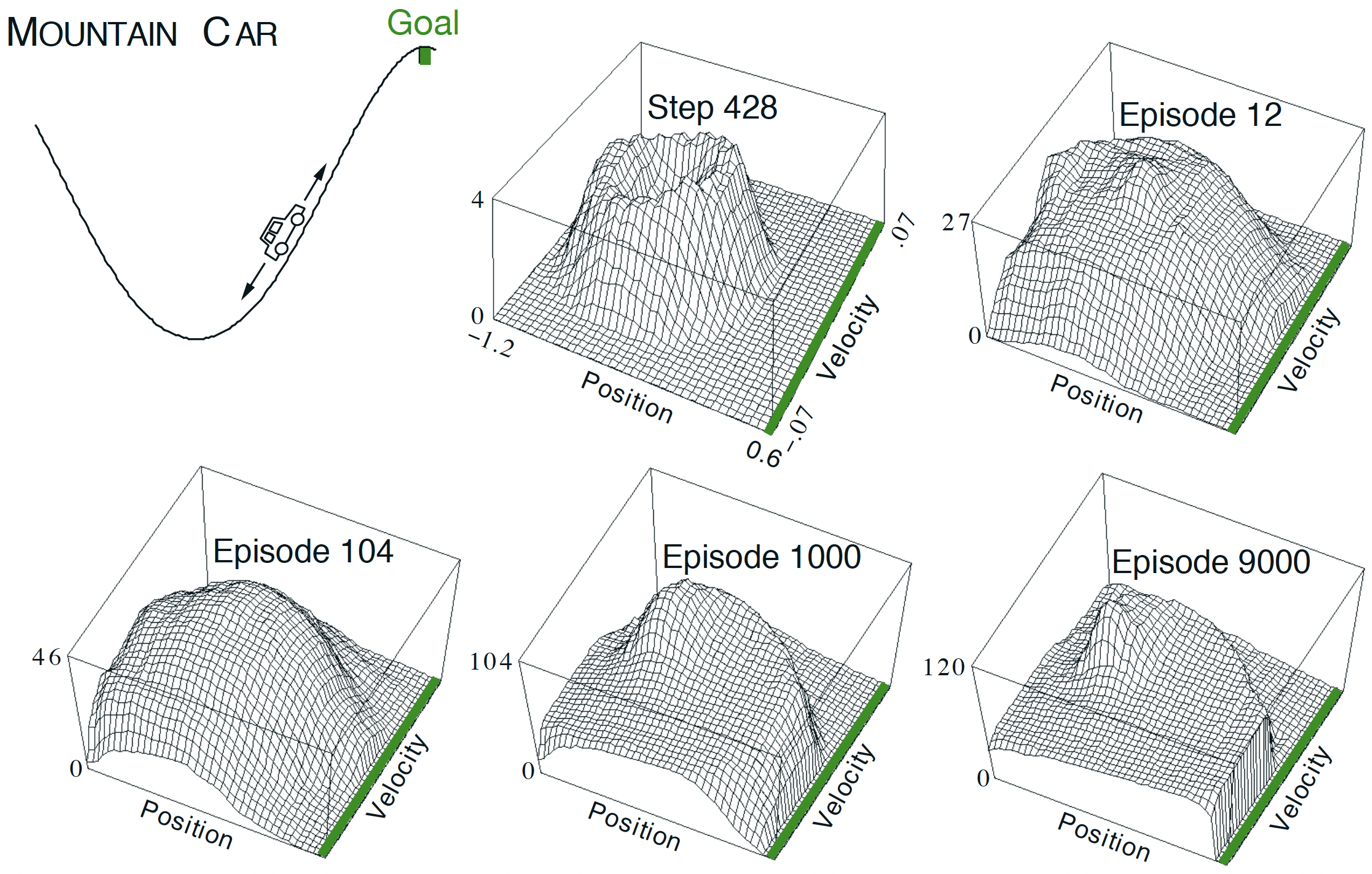
Example: Mountain car (1)
- Continous state \(s\in\Sc=[\submin{x},\submax{x}]\times[\submin{v},\submax{v}]\) (minimal and maximal position \(x\) and velocity \(v\)).
- Single, discrete action \(a\in\Ac=\set{-1,0,1}\).
- \(r = −1\) (goal is to terminate episode as quick as possible).
- Episode terminates when car reaches the flag (or max steps).
- Simplified longitudinal car physics with state constraints.
- Position initialized randomly within valley, zero initial velocity.
- Car is underpowered and requires swing-up.
Approximation: Linear model with tile coding features \(x_i(s,a)\), where \[ \begin{align*} \psi(s,a)&=\sum_{i=1}^d \theta_i x_i(s,a), \\ x_i(s,a)&=\begin{cases} 1 & (s,a)\in\text{ tile \#}i \\ 0 & \text{otherwise} \end{cases}. \end{align*} \]
Example: Mountain car (2)
Warning: a huge drawback of function approximation
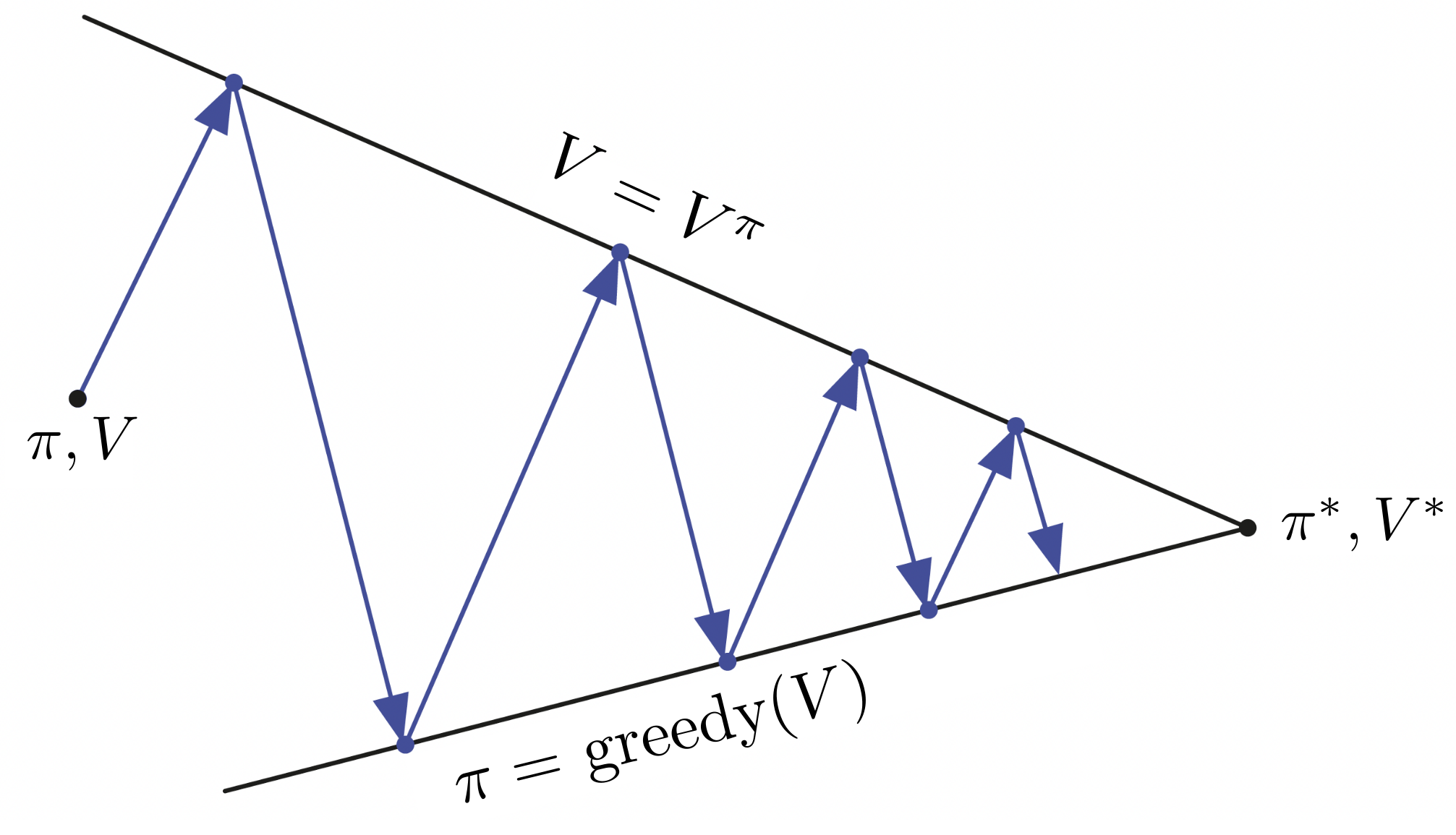
- Recall tabular policy improvement theorem: guarantee to find a globally better or equally good policy in each update step.
- Parameter updates of the form \(\eqref{eq:DQL_Q_update}\) have an impact on \(Q(s,a)\) for all \(s\) and \(a\), not just the one we visited!
Loss of the policy improvement theorem
- When using function approximation, the policy improvement theorem does no longer apply.
- While improving the policy, we may impair it in other places at the same time.
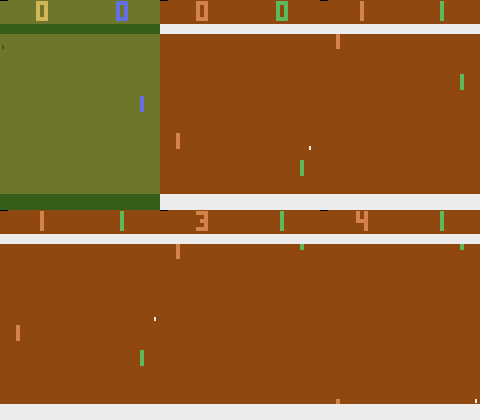
Example: Atari game Pong (1)
- State \(s\):
- \(210 \times 160\) pixels with \(3\) channels each (RGB) and values \(s_{i}\in\{0,\ldots,255\}\),
- stacking of multiple frames,
- some additional preprocessing.
- Action \(a\): \(18\) actions in total, (\(6\) buttons, some of which can be pushed at the same time).
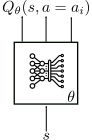
- Architecture for \(Q_\theta\) (Mnih et al. 2015):
 \(\qquad\)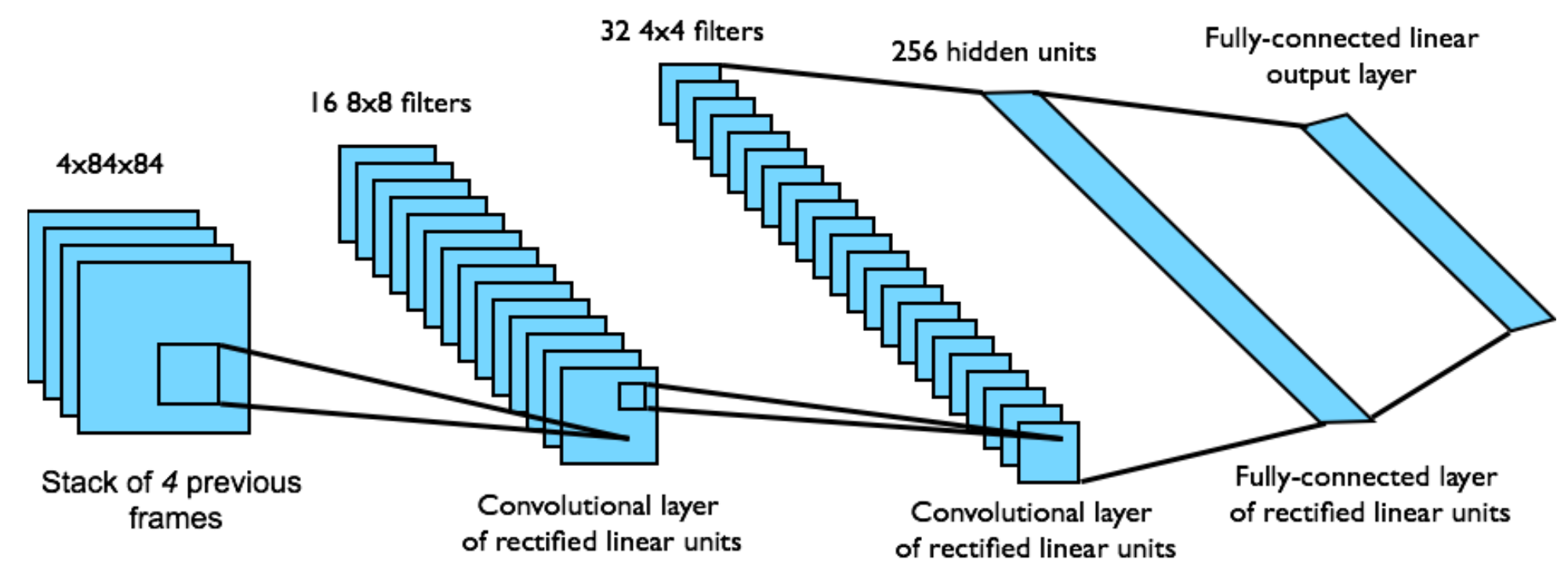
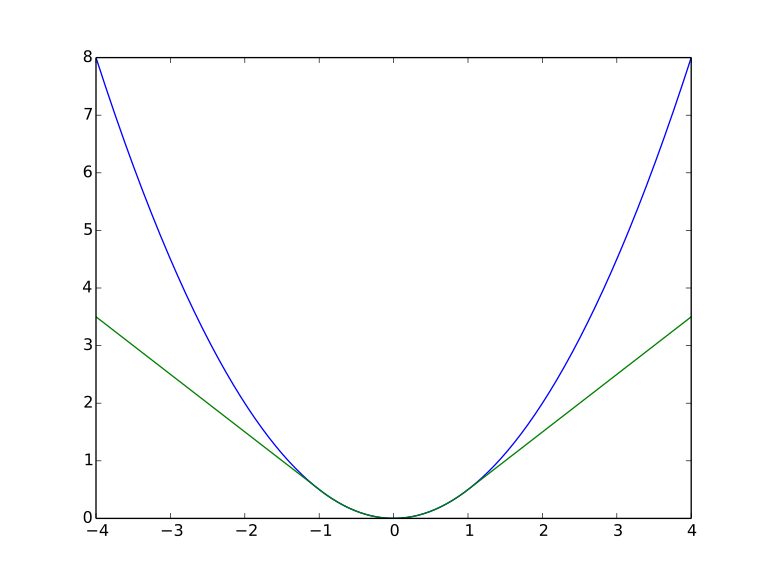
- Loss function \(L(\theta)\): Huber loss \(L_\beta(\theta) = \begin{cases} \frac{1}{2}\theta^2, & \theta \leq \beta \\ \beta(\abs{\theta} - \frac{1}{2}\theta), & \text{otherwise} \end{cases}\).
- Training: RMSProp descent algorithm.
- Annealing of the exploration rate: \(\epsilon\) goes from \(1\) to \(0.1\) (or \(0.05\)) over the first \(10^6\) frames.
Example: Atari game Pong (2)
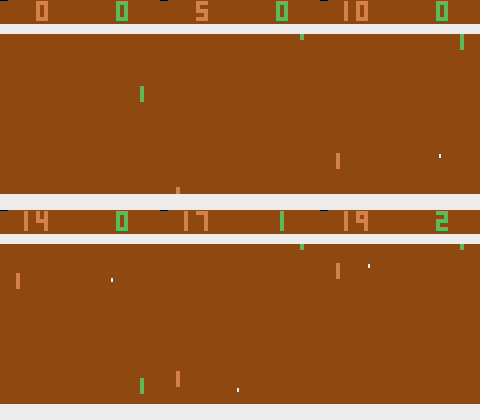
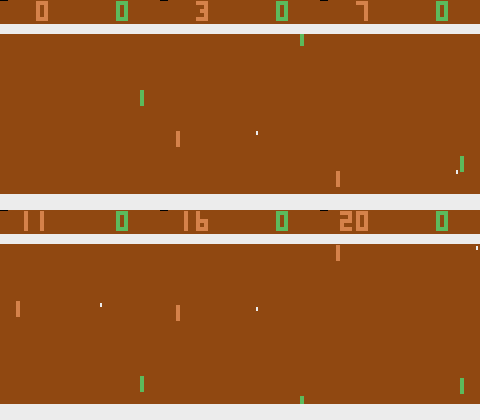 100,000 steps
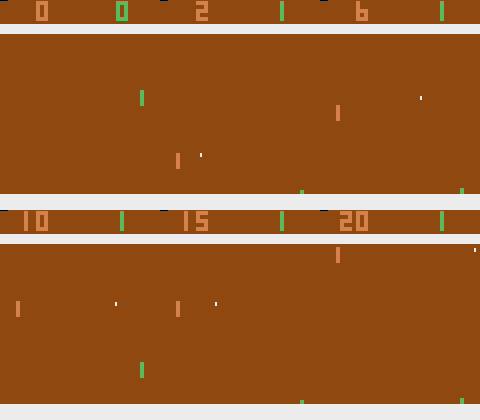 300,000 steps
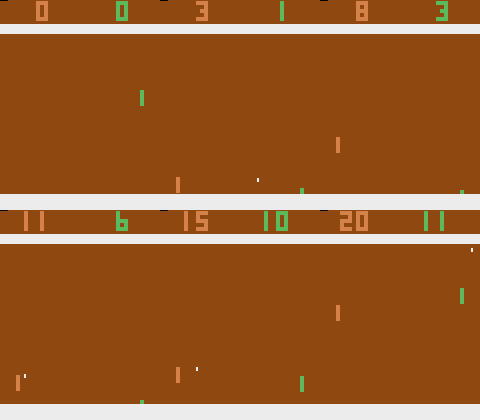 500,000 steps
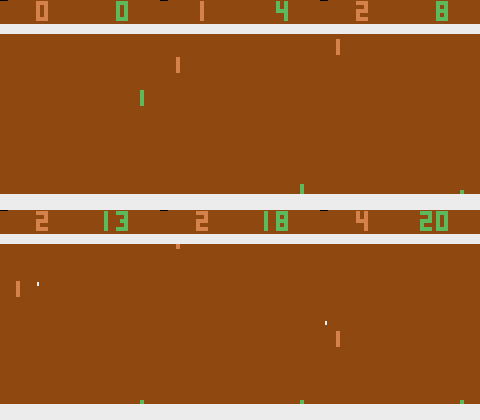 800,000 steps
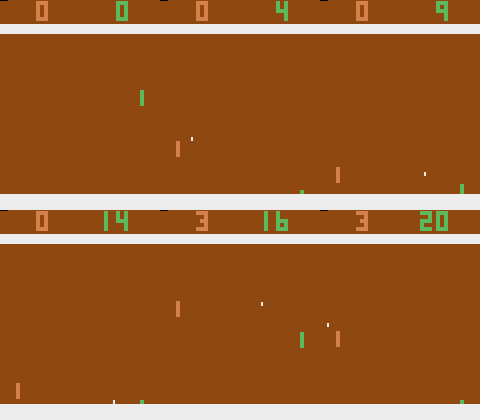 1,000,000 steps
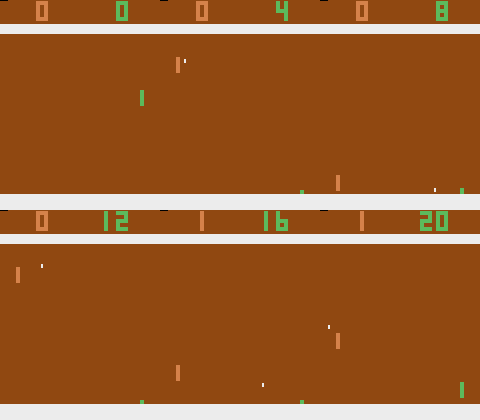 1,500,000 steps
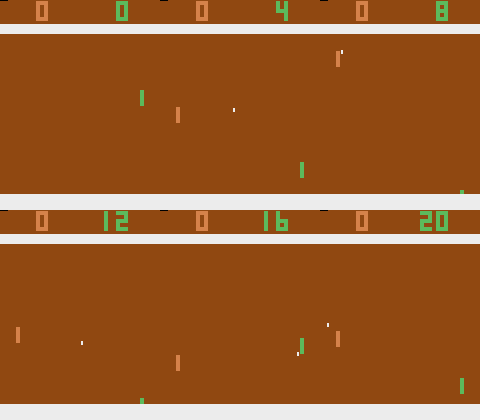 2,000,000 steps
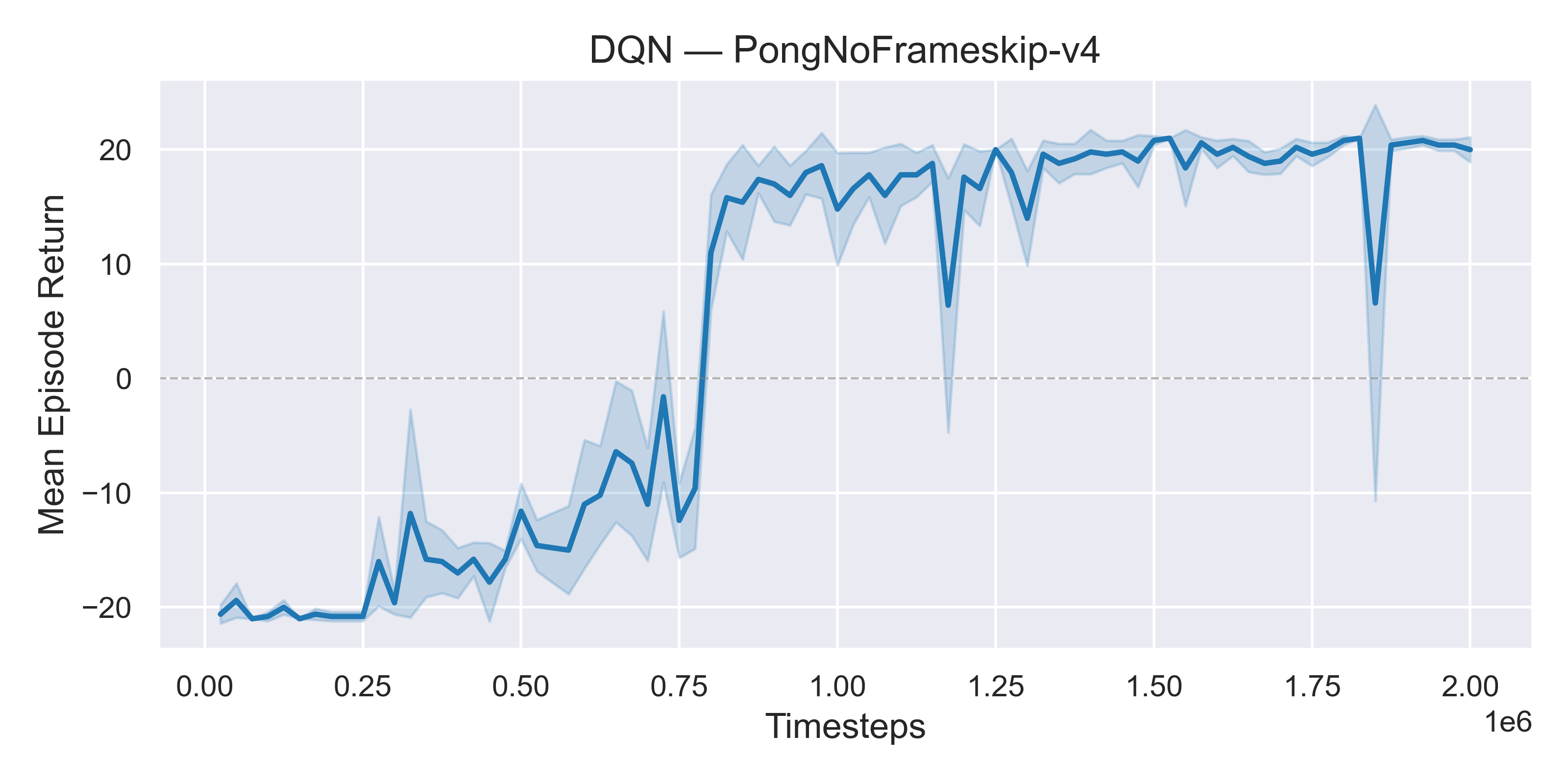
Example: Atari games
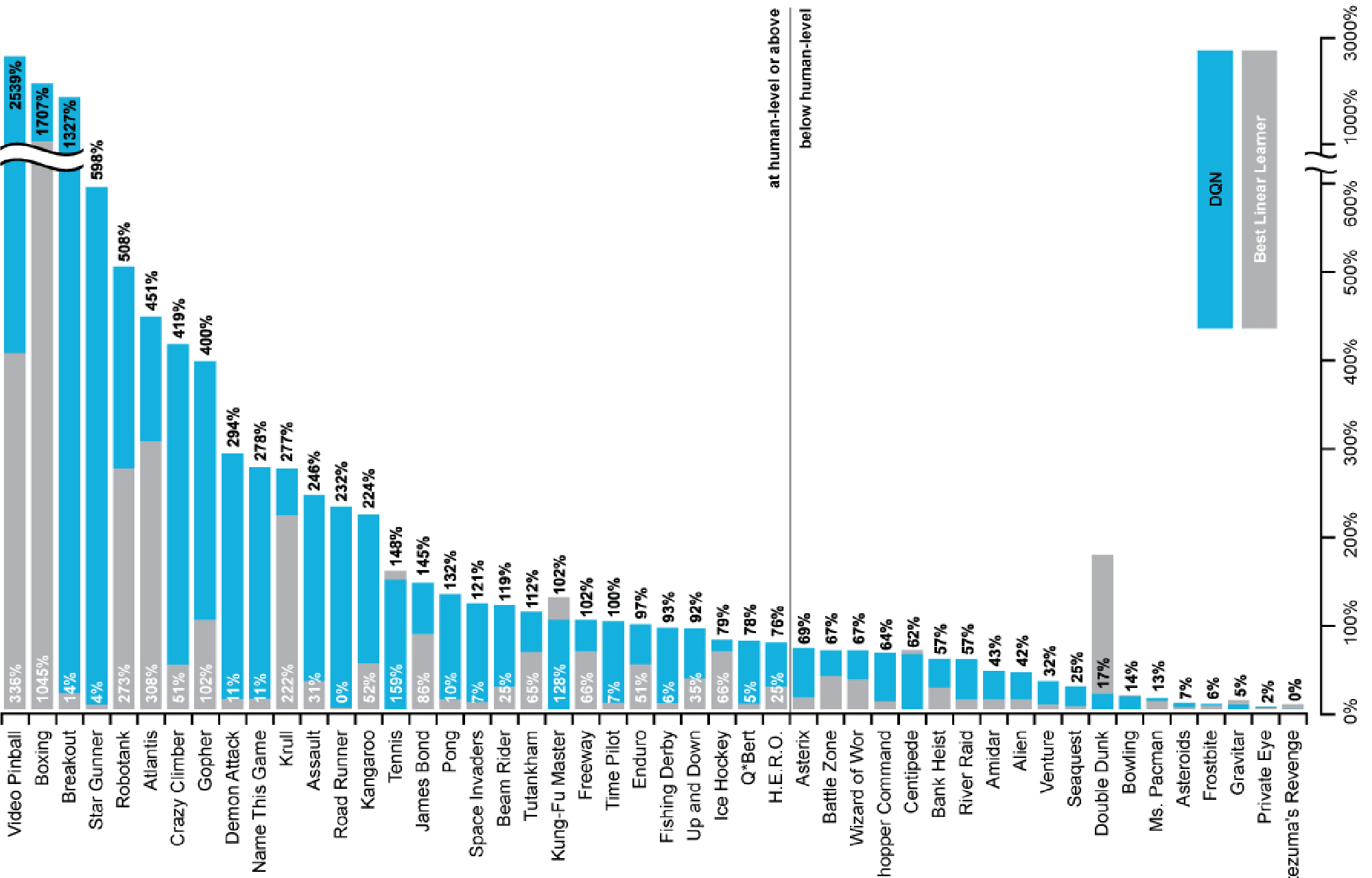
Double \(Q\) networks (Hasselt, Guez, and Silver 2016)
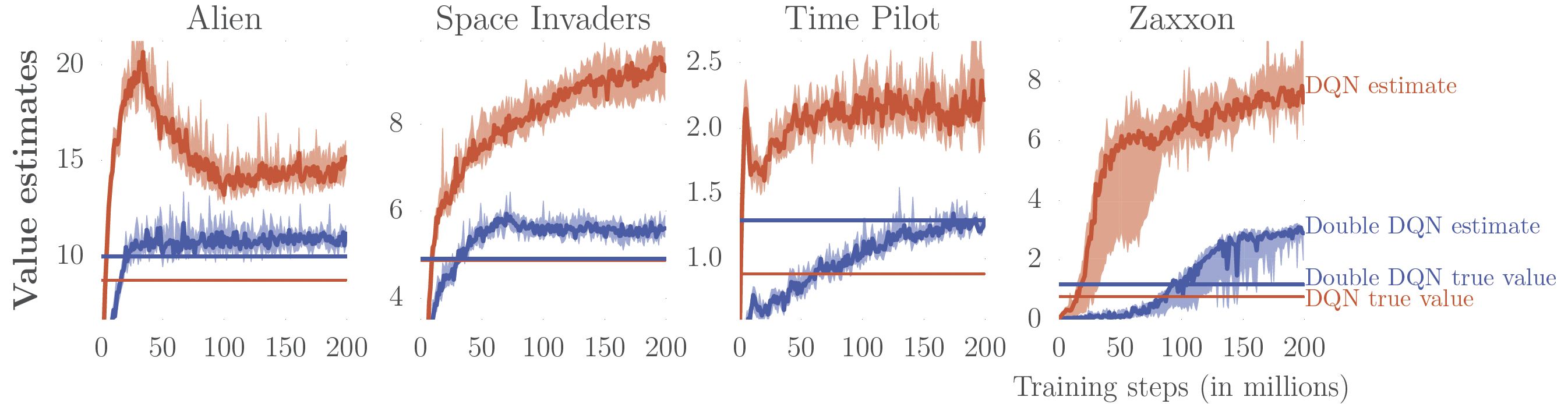
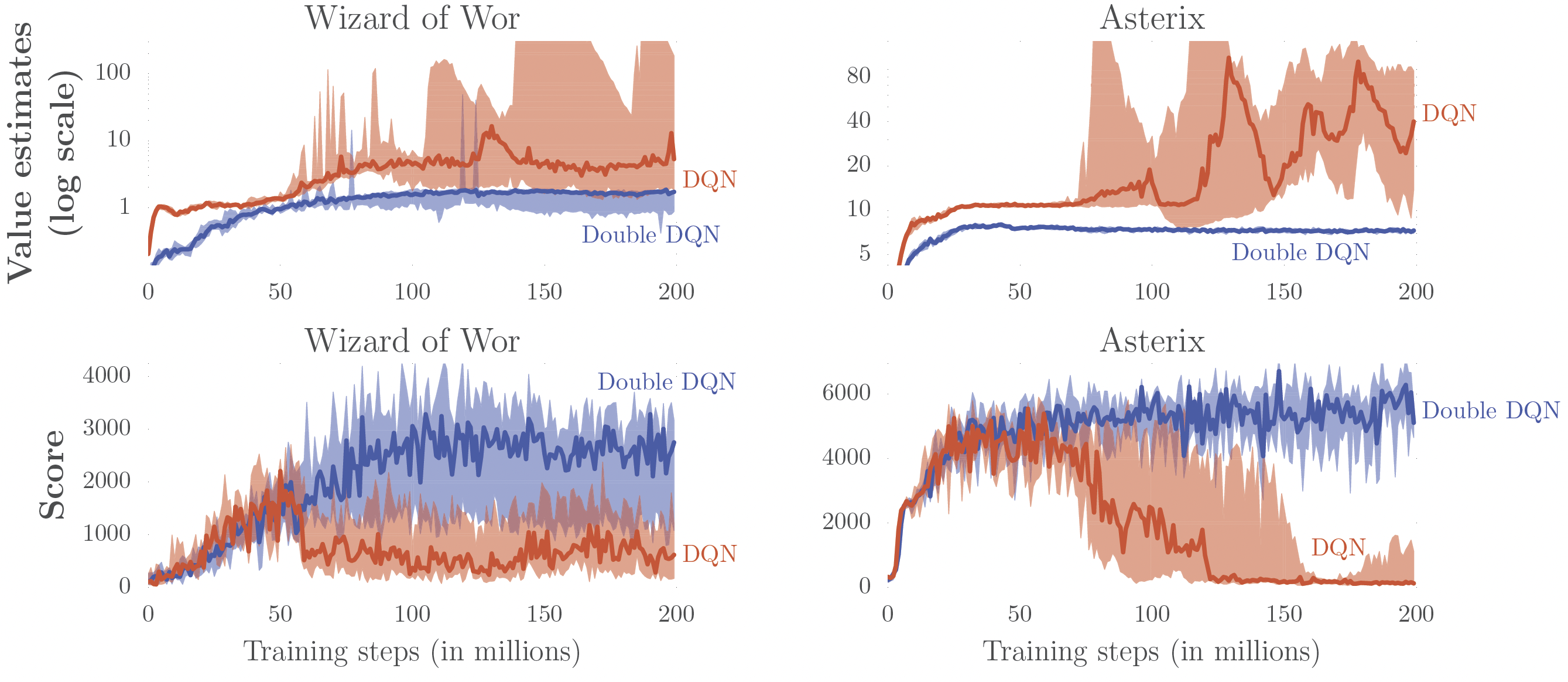
Remember the maximization bias and double \(Q\)-learning?
\(\Rightarrow\) Don’t use same network to choose the action and estimate the value!
Double deep \(Q\)-learning:
- Just use the current network (\(\theta\)) to evaluate the action.
- Still use the target network (\(\bar{\theta}\)) to evaluate the value. \[y = r + \gamma \textcolor{red}{Q_{\bar{\theta}}}(s',\arg\max_{a\in\Ac} \textcolor{blue}{Q_\theta}(s',a))\]
Algorithm recap: Tabular Q-Learning.
- Take \(a_t\) (\(\epsilon\)-greedy on \(Q_1 + Q_2\)), observe \((r_t,s_{t+1})\)
- if \(\mathsf{rand()} > 0.5\) then \[\begin{align*} &y = r_t + \gamma \textcolor{red}{Q_2}(s_{t+1},\arg\max_{a\in\Ac} \textcolor{red}{Q_1}(s_{t+1},a))\\ &Q_1(s_t,a_t) \gets Q_1(s_t,a_t) + \alpha \left[y - Q_1(s_t,a_t)\right] \end{align*}\]
- else: …
Prioritized experience replay (Schaul et al. 2016)
- Samples in the replay buffer are not equally important.
- From some examples, you can learn more than from others.
- What would be a good criterion to assess the relevance of a particular sample? \(\Rightarrow\) The TD error \[\delta_i = r_i + \max_{a\in\Ac}Q_{\bar{\theta}}(s_i',a) - Q_\theta(s_i,a_i)\]
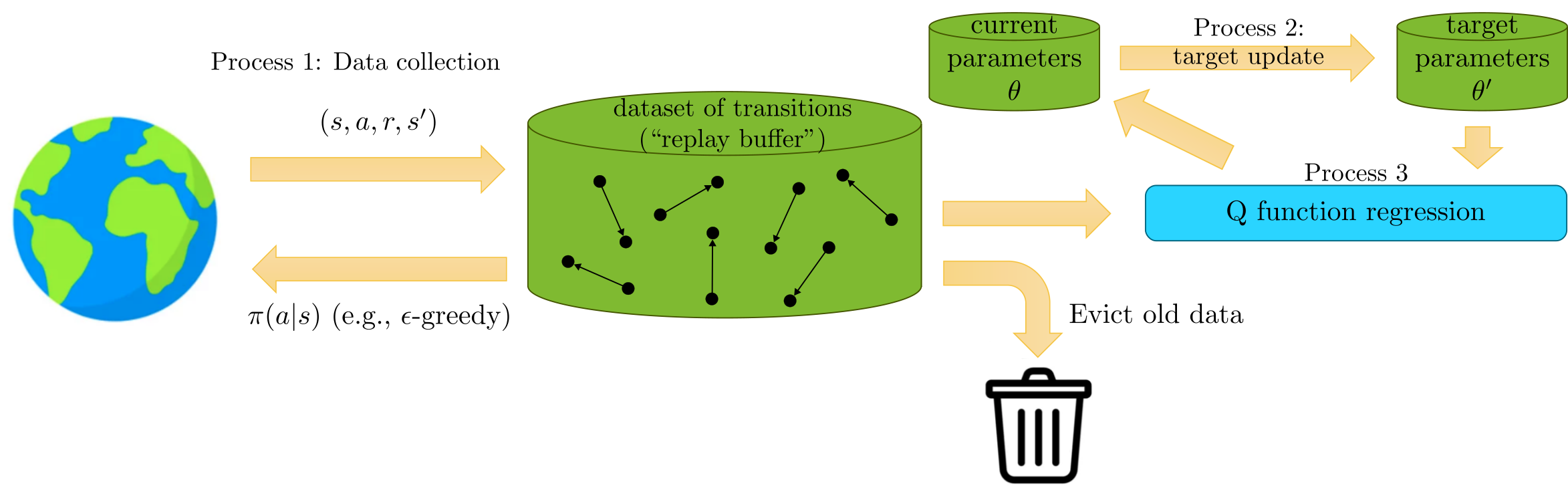
- Instead of sampling uniformly from the replay buffer, we assign an individual probability to each sample: \[ P(i) = \frac{p_i^\alpha}{\sum_{k=1}^{\abs{\Dc}}p_k^\alpha}, \qquad p_i = \abs{\delta_i} + \epsilon.\]
- Here, \(\alpha\geq 0\) determines the degree of prioritization (\(\alpha=0\) is the uniform case).
- The parameter \(\epsilon>0\) ensures that all samples are drawn with non-zero probability.
- A version that’s less sensitive to outliers: rank the transitions according to \(\abs{\delta_i}\): \[p_i = \frac{1}{\mathsf{rank}(i)}.\]
- But: this introduces a bias (we sample from a different, uncontrollable distribution) \(\Rightarrow\) Use importance sampling!
Some practical tips
Following Sergey Levine’s CS285 lecture:
- Q learning takes some care to stabilize.
- Test on easy, reliable tasks first, make sure your implementation is correct.
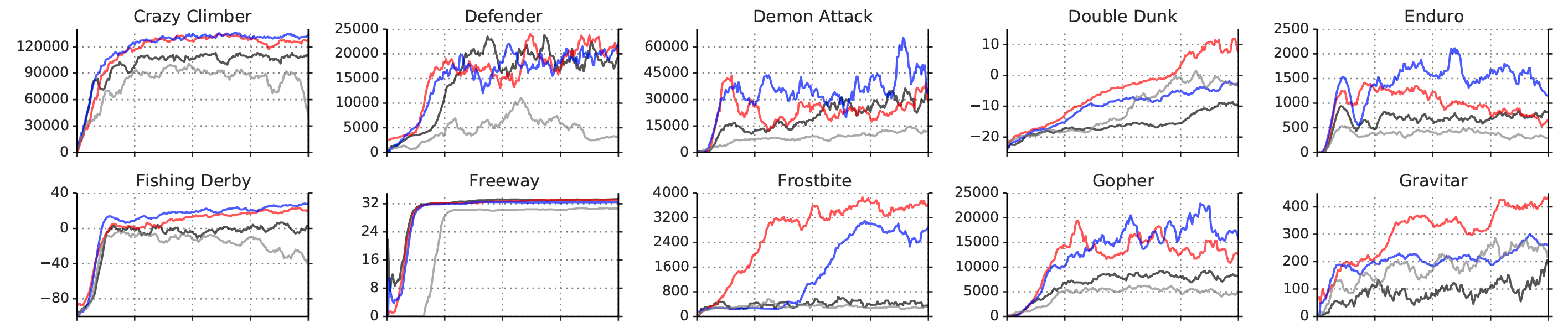 (Schaul et al. 2016)
- Test on easy, reliable tasks first, make sure your implementation is correct.
- Large replay buffers help improve stability.
- Looks more like fitted Q iteration.
- It takes time, be patient; performance might be no better than random for a while.
- Start with high exploration (\(\epsilon\)) and gradually reduce.
- Bellman error gradients can be big; clip gradients or use Huber loss.
- Double Q learning helps a lot in practice: it’s simple and has no downsides.
- \(n\)-step returns also help a lot, but have some downsides.
- Schedule exploration (high to low) and learning rates (high to low). The Adam optimizer can help too.
- Run multiple random seeds, it’s very inconsistent between runs.
Least squares policy iteration (LSPI)
General idea:
- Apply general policy improvement (GPI) based on dataset \(\Dc\),
- Policy evaluation by off-policy LS-SARSA,
- Policy improvement by greedy choices on predicted action values.
Some remarks:
- LSPI is an offline and off-policy control approach.
- Exploration is required by feeding suitable sampling distributions to \(\Dc\):
- \(\epsilon\)-greedy choices based on \(Q_\theta\).
- Completely random samples are conceivable as well.
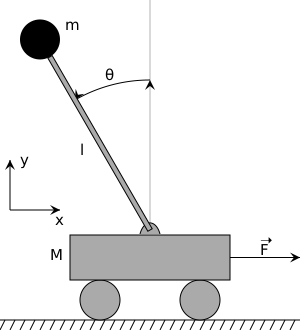
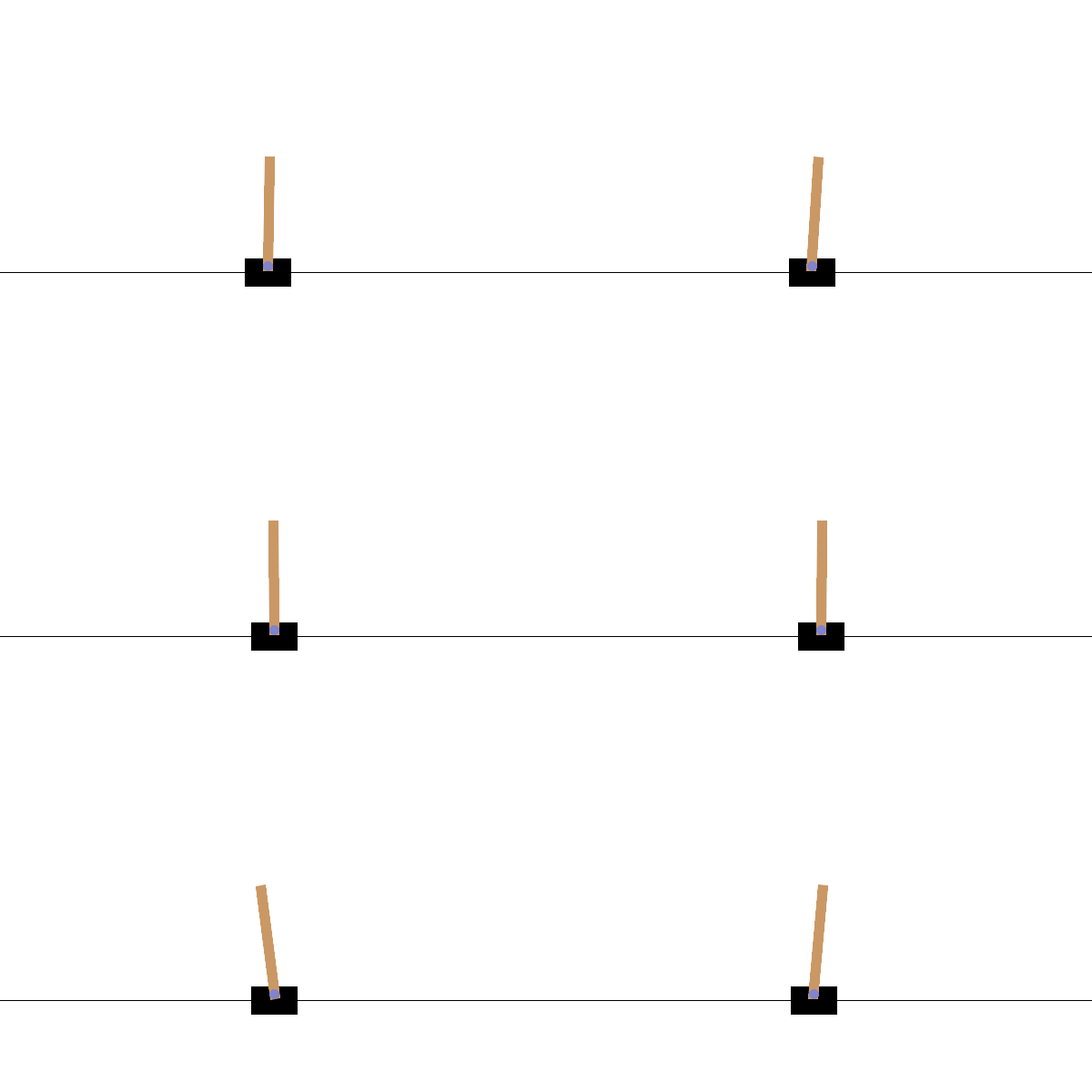
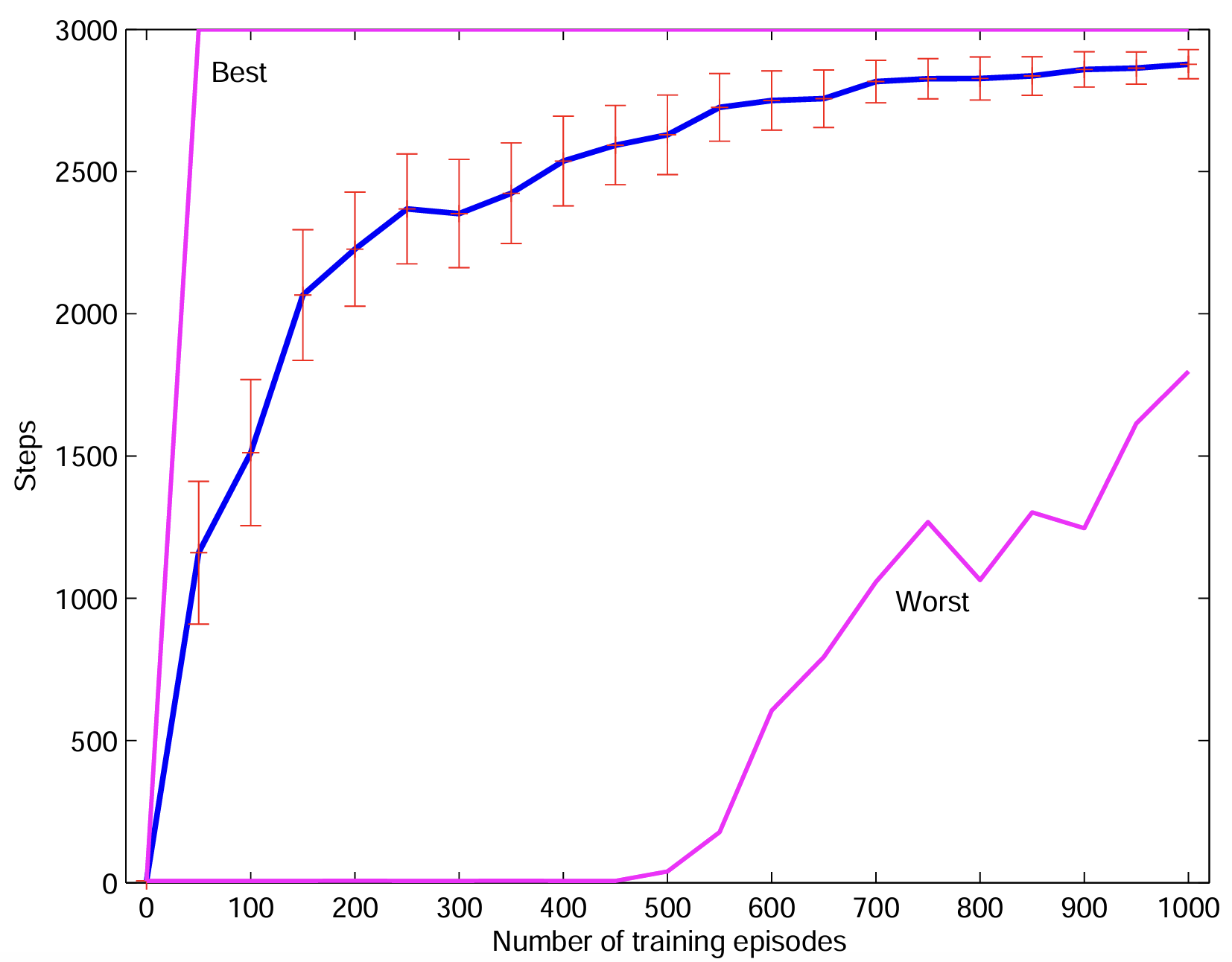
Example: Pendulum on a cart (Abdelwanis et al. 2026)