Deep Reinforcement Learning

Policy Gradients

Prof. Dr. Sebastian Peitz

Chair of Safe Autonomous Systems, TU Dortmund

Summer term 2026

🚀 by Decker

Content

Content

  • From value-based methods to direct policy optimization
  • Policy gradients
    • The objective
    • Evaluation the objective
    • Differentiating the objective
  • The REINFORCE algorithm
  • Understanding and challenges
  • Reducing the variance
    • Baselines
    • Reward to go
  • Off-policy policy gradients
  • Some implementation details

Where are we?

Lecture contents
Chapter Topic Content
Basics & tabular methods
1-5 Bandits, MDPs, Dynamic Programming, Monte Carlo, TD Learning RL basics in finite dimensions
Deep-learning-based methods
6 Brief introduction to deep learning The basics for what comes next
7 Value function approximation Value estimation with function approximation
8 Deep \(Q\)-learning \(Q\)-learning with neural networks
9 Policy gradients Direct optimization of the policy
10 Actor-critic algorithms
11 Advanced algorithms (Part I): From policy gradient to PPO
12 Advanced algorithms (Part II): From \(Q\)-learning to Soft Actor-Critic
Model-Based Control
Advanced Topics

From value-based methods to direct policy optimization

From value-based methods to direct policy optimization

  • Until now, all approaches followed the GPI concept.
  • These are all value-based methods: Need an estimate of \(V^\pi\) or \(Q^\pi\) to improve \(\pi\).
  • But: what are we after in RL, really? \(\Rightarrow\) The optimal policy \(\pi^*\)! Inspired by Sergey Levine’s CS285 lecture.

Inspired by Sergey Levine’s CS285 lecture.

Alternative approach:

  1. Define probabilities over entire trajectories.
  2. Formulate RL objective; optimize dynamics via policy parameters \(\phi\).

\[ \begin{align*} &\Rightarrow\quad p_\phi(\underbrace{s_0,a_0,\ldots,s_{T-1},a_{T-1},s_{T}}_{=\tau}) \fragment{= p_\phi(\tau)} \fragment{= p(s_0) \prod_{t=0}^{T-1} \pi_\phi\agivenb{a_t}{s_t} \pC{s_{t+1}}{s_t,a_t}.} \\ &\Rightarrow\quad \phi^* = \arg\max_{\phi}\Expsub{\sum_{t=0}^{T-1}r_t}{\tau\sim p_\phi(\tau)} \fragment{ = \arg\max_{\phi}\Expsub{V^{\pi_\phi}(s_0)}{s_0 \sim p(s_0)}. } \end{align*} \]

Policy gradients

The reinforcement learning objective

\[ \begin{align*} \phi^* &= \arg\max_{\phi}\Expsub{\sum_{t=0}^{T-1}r_t}{\tau\sim p_\phi(\tau)} = \arg\max_{\phi}\Expsub{r(\tau)}{\tau\sim p_\phi(\tau)}\\ \text{Infinite horizon case:}\quad\phi^* &= \arg\max_{\phi}\Expsub{r}{(s,a)\sim p_\phi(s,a)}\\ \text{Finite horizon case:}\quad\phi^* &= \arg\max_{\phi}\sum_{t=0}^{T-1}\Expsub{r_t}{(s_t,a_t)\sim p_\phi(s_t,a_t)} \end{align*} \]

  • Infinite horizon: expected reward according to the stationary distributions of \(s\) and \(a\).
  • Finite horizon: linearity \(\Rightarrow\) expected reward of individual stages (may differ with \(t\)).
  • We are sticking to the finite-horizon case here.

Evaluating the objective

\[ \phi^* = \arg\max_{\phi}\underbrace{\Expsub{\sum_{t=0}^{T-1}r_t}{\tau\sim p_\phi(\tau)}}_{L(\phi)} \]

  • First, let’s think about evaluating \(L(\phi)\) for a fixed policy \(\pi\).
  • How do we estimate expectations if we don’t have access to a model?

\(\Rightarrow\) Monte Carlo sampling! \[L(\phi) = \Expsub{\sum_{t=0}^{T-1}r_t}{\tau\sim p_\phi(\tau)} \approx \frac{1}{N}\sum_{i=1}^N \sum_{t=0}^{T-1}r_{i,t} \]

Inspired by Sergey Levine’s CS285 lecture.

  • Sample \(N\) trajectories with \(s_0\) according to the initial distribution and then following \(\pi\).
  • Take the sample average over these trajectories.

Policy gradient: Depending on the return, the plan is to increase or reduce the trajectories’ likelihoods by adapting the policy \(\pi\).

Differentiating the policy (1)

Definition of the expectation in continuous spaces

The expected value of a function \(x(\tau)\) is

\[ \Expsub{x(\tau)}{\tau\sim p} = \int p(\tau) x(\tau) \dtau. \]

Here, \(p\) is the density according to which \(\tau\) is distributed, with \(\int p(\tau) \dtau = 1\).

\[ \begin{align*} \phi^* &= \arg\max_{\phi}\underbrace{\Expsub{\sum_{t=0}^{T-1}r_t}{\tau\sim p_\phi(\tau)}}_{L(\phi)}\\ L(\phi) &= \E_{\tau\sim p_\phi(\tau)}[\underbrace{r(\tau)}_{=\sum_{t=0}^{T-1}r_t}] = \int p_\phi(\tau) r(\tau) \dtau\\ \nablaphi L(\phi) &= \nablaphi \rbracket{\int p_\phi(\tau) r(\tau) \dtau}\\ &= \int \textcolor{red}{\nablaphi p_\phi(\tau)} r(\tau) \dtau \end{align*}\]

Note: Integration and differentiation are linear \(\Rightarrow\) We can swap!

A convenient identity

\[ \begin{equation} \textcolor{red}{\nablaphi p_\phi(\tau)} \fragment{ = p_\phi(\tau) \frac{\nablaphi p_\phi(\tau)}{p_\phi(\tau)} } \fragment{ = \textcolor{blue}{p_\phi(\tau) \nablaphi \log p_\phi(\tau)} } \label{eq:PG_log_identity} \end{equation} \]

\[\begin{align*} \quad~= \int \textcolor{blue}{p_\phi(\tau) \nablaphi \log p_\phi(\tau)} r(\tau) \dtau \end{align*} \] \[\begin{align} \quad = \Expsub{\nablaphi \log p_\phi(\tau) r(\tau)}{\tau\sim p_\phi(\tau)} \label{eq:PG_policy_gradient} \end{align} \]

Differentiating the policy (2)


\[ \begin{align*} \phi^* &= \arg\max_{\phi}L(\phi)\\ L(\phi) &= \Expsub{r(\tau)}{\tau\sim p_\phi(\tau)} = \int p_\phi(\tau) r(\tau) \dtau\\ \nablaphi L(\phi) &= \Expsub{\textcolor{blue}{\nablaphi \log p_\phi(\tau)} r(\tau)}{\tau\sim p_\phi(\tau)} \end{align*}\]

\[\begin{align*} \underbrace{p_\phi(s_0,a_0,\ldots,s_{T-1},a_{T-1},s_{T})}_{=p_\phi(\tau)} &= p(s_0) \prod_{t=0}^{T-1} \pi_\phi\agivenb{a_t}{s_t} \pC{s_{t+1}}{s_t,a_t} \\ \text{take log on both sides!}\quad &\Downarrow \quad\fragment{ \textcolor{gray}{(\log(a\cdot b) = \log(a) + \log(b))} } \\ \log p_\phi(\tau) = \log p(s_0) + &\sum_{t=0}^{T-1} \rbracket{\log\pi_\phi\agivenb{a_t}{s_t} + \log \pC{s_{t+1}}{s_t,a_t}} \end{align*}\]

\[\begin{align*} \textcolor{blue}{\nablaphi \log p_\phi(\tau)} &= \nablaphi \rbracket{\log p(s_0) + \sum_{t=0}^{T-1} \rbracket{\log\pi_\phi\agivenb{a_t}{s_t} + \log \pC{s_{t+1}}{s_t,a_t}}}\\ &= \nablaphi \log p(s_0) + \sum_{t=0}^{T-1} \rbracket{\nablaphi \log\pi_\phi\agivenb{a_t}{s_t} + \nablaphi \log \pC{s_{t+1}}{s_t,a_t}}\\ &= \textcolor{red}{\underbrace{\cancel{\nablaphi \log\, p(s_0)}}_{=0}} + \sum_{t=0}^{T-1} \nablaphi \log\pi_\phi\agivenb{a_t}{s_t} + \textcolor{red}{\underbrace{\cancel{\nablaphi \log\, \pC{s_{t+1}}{s_t,a_t}}}_{=0}} \end{align*}\]

Policy gradient theorem (simplified)

\[\begin{align*} \nablaphi L(\phi) = \Expsub{\cbracket{\sum_{t=0}^{T-1} \nablaphi \log\pi_\phi\agivenb{a_t}{s_t}}r(\tau)}{\tau\sim p_\phi(\tau)}\\ = \Expsub{\cbracket{\sum_{t=0}^{T-1} \nablaphi \log\pi_\phi\agivenb{a_t}{s_t}}\cbracket{\sum_{t=0}^{T-1}r_t}}{\tau\sim p_\phi(\tau)} \end{align*}\]

Policy gradient theorem

What does this mean?

  1. Goal: find a policy that maximizes the value, \[\max_{\pi}\Expsub{\sum_{t=0}^{T-1}r_t}{\tau\sim p^\pi} = \max_{\pi}\Expsub{r(\tau)}{\tau\sim p^\pi}.\]

Policy gradient theorem (simplified)

\[\nablaphi L(\phi) = \Expsub{\cbracket{\sum_{t=0}^{T-1} \nablaphi \log\pi_\phi\agivenb{a_t}{s_t}}\cbracket{\sum_{t=0}^{T-1}r_t}}{\tau\sim p_\phi(\tau)}\]

  1. Neural network approximator \(\pi_\phi\) \(\Rightarrow\) maximization w.r.t. the policy parameters: \[\max_{\phi}\Expsub{r(\tau)}{\tau\sim p_\phi(\tau)} = \max_{\phi}L(\phi).\]
  2. Challenging objective function: Integration over \(\tau\) (i.e., the space of trajectories) is infeasible! \[L(\phi) = \Expsub{r(\tau)}{\tau\sim p_\phi(\tau)} = \int p_\phi(\tau) r(\tau) \dtau. \]
  3. Use \(\log\) identity to derive a formulation of the gradient that we can approximate using sampling: \[ \nablaphi L(\phi) = \Expsub{\cbracket{\sum_{t=0}^{T-1} \nablaphi \log\pi_\phi\agivenb{a_t}{s_t}}\cbracket{\sum_{t=0}^{T-1}r_t}}{\tau\sim p_\phi(\tau)}.\]

REINFORCE

We now have a formulation of the policy gradient that we can approximate using Monte Carlo sampling: \[ \nablaphi L(\phi) = \Expsub{\cbracket{\sum_{t=0}^{T-1} \nablaphi \log\pi_\phi\agivenb{a_t}{s_t}}\cbracket{\sum_{t=0}^{T-1}r_t}}{\tau\sim p_\phi(\tau)} \fragment{ \approx \textcolor{blue}{\frac{1}{N} \sum_{i=1}^N} \underbrace{\textcolor{blue}{\cbracket{\sum_{t=0}^{T-1} \nablaphi \log\,\pi_\phi\agivenb{a_{i,t}}{s_{i,t}}}}}_{\fragment{ \text{(I)} }}\underbrace{\textcolor{blue}{\cbracket{\sum_{t=0}^{T-1}r_{i,t}}}}_{\fragment{ \text{(II)} }}. }\]

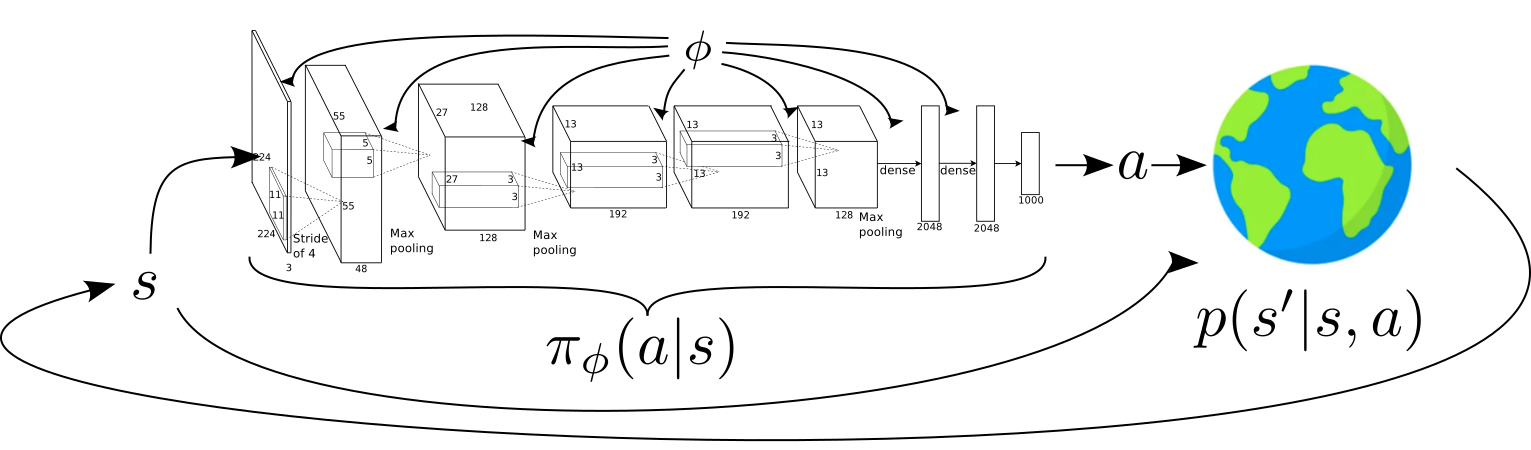
(I) This term is simpliy the derivative of the policy network w.r.t. the weights \(\Rightarrow\) backpropagation!
(II) This term is the experience we collect from interactions with the environment.
images/09-policy-gradients/CNN-policy.svg

The REINFORCE algorithm

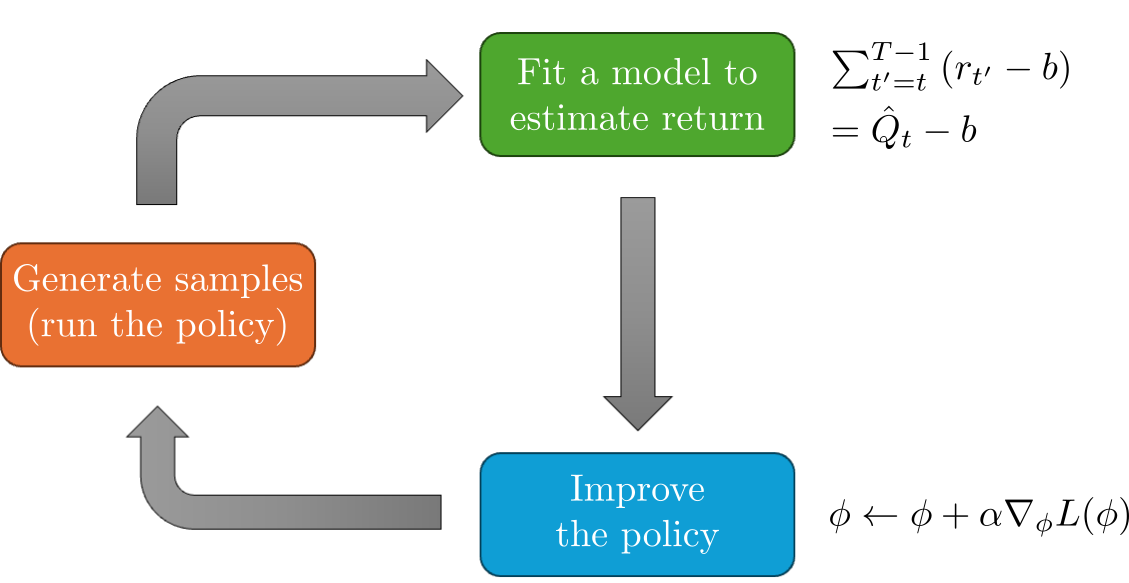
  1. Sample \(\set{\tau_i}_{i=1}^N\) using \(\pi_\phi\agivenb{a}{s}\) \(\Rightarrow\) \(\set{((s_{i,0},a_{i,0},r_{i,0}),\ldots,(s_{i,T-1},a_{i,T-1},r_{i,T-1}))}_{i=1}^N\).
  2. \(\nablaphi L(\phi) \approx \frac{1}{N} \sum_{i=1}^N \cbracket{\sum_{t=0}^{T-1} \nablaphi \log\pi_\phi\agivenb{a_{i,t}}{s_{i,t}}}\cbracket{\sum_{t=0}^{T-1}r_{i,t}}\).
  3. Gradient ascent: \(\phi \gets \phi + \alpha \nablaphi L(\phi)\).

Understanding the policy gradient

Continuous action example: A Gaussian policy

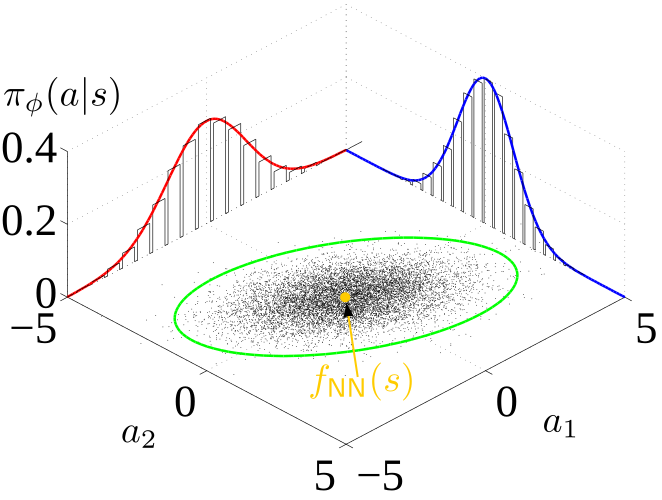
  • Assume a Gaussian policy whose mean is given by a neural network: \[ \begin{align*} \pi_\phi\agivenb{a}{s} &= \Normal{f_{\mathsf{NN}}(s)}{\Sigma} \\ &= \frac{1}{C}\exp\cbracket{-\frac{1}{2}(a - f_{\mathsf{NN}}(s))^\top \Sigma^{-1} (a - f_{\mathsf{NN}}(s))} \\ &= \frac{1}{C}\exp\cbracket{-\frac{1}{2}\norm{a - f_{\mathsf{NN}}(s)}_\Sigma^2}. \end{align*}\]
  • Taking the log (with \(\log C^{-1} = - \log C\)) yields: \[ \log \pi_\phi\agivenb{a}{s} = -\frac{1}{2}\norm{a - f_{\mathsf{NN}}(s)}_\Sigma^2 - \log C.\]
  • Taking the gradient leads to the following expression: \[-\frac{1}{2}\Sigma^{-1} (f_{\mathsf{NN}}(s) - a) \pdiff{f_{\mathsf{NN}}}{\phi}.\]
images/09-policy-gradients/multivariate-normal-distribution.svg
Adapted from Wikipedia.

The REINFORCE algorithm

  1. Sample \(\set{\tau_i}_{i=1}^N\) using \(\pi_\phi\agivenb{a}{s}\) \(\Rightarrow\) \(\set{((s_{i,0},a_{i,0},r_{i,0}),\ldots,(s_{i,T-1},a_{i,T-1},r_{i,T-1}))}_{i=1}^N\).
  2. \(\nablaphi L(\phi) \approx \frac{1}{N} \sum_{i=1}^N \cbracket{\sum_{t=0}^{T-1} \nablaphi \log\pi_\phi\agivenb{a_{i,t}}{s_{i,t}}}\cbracket{\sum_{t=0}^{T-1}r_{i,t}}\).
  3. Gradient ascent: \(\phi \gets \phi + \alpha \nablaphi L(\phi)\).

Comparison to maximum likelihood

  • Consider the task of maximizing the likelihood \(L\) of a training dataset \(\Dc=\set{(x_i,y_i)}_{i=1}^N\) in supervised learning, e.g., using a neural network with parameter vector \(\theta\): \[ \begin{align*} \max_\theta L(\theta) &= \max_\theta p_\theta\agivenb{y_1}{x_1} \times \ldots \times p_\theta\agivenb{y_N}{x_N} \\ &= \max_\theta \prod_{i=1}^N p_\theta\agivenb{y_i}{x_i}. \end{align*} \]
  • Optimizing over products is hard \(\Rightarrow\) take the log: \[ \log L(\theta) = \log \cbracket{\prod_{i=1}^N p_\theta\agivenb{y_i}{x_i}}= \sum_{i=1}^N \log p_\theta\agivenb{y_i}{x_i}. \]

Maximum likelihood gradient: \[\nablatheta \log L(\theta) = \sum_{i=1}^N \nablatheta \log p_\theta\agivenb{y_i}{x_i}.\]

Comparison against the policy gradient (MC sampling):

\[ \nablaphi L(\phi) \approx \frac{1}{N} \sum_{i=1}^N \cbracket{\sum_{t=0}^{T-1} \nablaphi \log\pi_\phi\agivenb{a_{i,t}}{s_{i,t}}}\cbracket{\sum_{t=0}^{T-1}r_{i,t}}.\]

  • The policy gradient can be seen as a weighted version of the maximum likelihood objective.
  • Why is weighting is necessary?
    • In maximum likelihood, we always want to maximize the likelihood of the “correct” labels.
    • In policy gradients, we may also want to reduce the likelihood of low-reward samples!

Understanding the policy gradient

2026-05-15T07:46:31.381362image/svg+xmlMatplotlib v3.10.7, https://matplotlib.org/
Inspired by Sergey Levine’s CS285 lecture.
  • What did we just do?
    \(\Rightarrow\) let’s rewrite the formula a little and compare against maixmum likelihood: \[ \nablaphi L(\phi) \approx \frac{1}{N} \sum_{i=1}^N \underbrace{\nablaphi \log\,\pi_\phi(\tau_i)}_{\sum_{t=0}^{T-1} \nablaphi \log\pi_\phi\agivenb{a_{i,t}}{s_{i,t}}}\underbrace{r(\tau_i)}_{\sum_{t=0}^{T-1}r_{i,t}} \quad \text{vs.} \quad \nablatheta L(\theta) = \sum_{i=1}^N \nablatheta \log \pi_\phi(\tau_i). \]
  • Good experience is made more likely: We increase the proability of the policy to produce similar trajectories.
  • Bad experience is made less likely.
  • This simply formalizes the notion of “trial and error”!


A note on partial observability (without going into details)

The policy gradient also holds for partially observed MDPs (POMDPs). That is, for policies \(\policy{a}{o}\). In simple terms, the reason is that the policy gradient theorem does not make use of the Markov property.

Challenges with policy gradients

High variance

Inspired by Sergey Levine’s CS285 lecture.

\[\nablaphi L(\phi) \approx \frac{1}{N} \sum_{i=1}^N \nablaphi \log\pi_\phi(\tau_i) r(\tau_i). \]

  • Adding a constant to the reward should not change the optimal policy!
    • This is true for any optimization problem, e.g., \[\arg\min_x f(x) = \arg\min_x \rbracket{f(x) + 1000}.\]
  • In the limit \(N\rightarrow\infty\), this is true for policy gradients as well…
    • … but it does not hold for finite sample sizes, in particular few sample trajectories.
  • Depending on the sign of \(r(\tau)\), we either increase or decrease the probability of seeing similar trajectories \(\tau_i\) (and their rewards \(r(\tau_i)\)) in the future.
  • This is an instance of the high variance issue with policy gradients.
  • An even more “catastropic” version of this: What if we scale some of the rewards to be exactly zero?

Reducing variance – baselines

\[\nablaphi L(\phi) \approx \frac{1}{N} \sum_{i=1}^N \nablaphi \log\pi_\phi(\tau_i) r(\tau_i). \]

  • Question: Is there a systematic way to fix the challenge of reward offsets?
    \(\Rightarrow\) Let’s balance the “weight” of of our likelihood objective in such a way that …
    • Better-than-average rewards increase the probability of the respective trajectories.
    • Worse-than-average rewards decrease the probability.
  • Several advantages!
    • This aligns with our intuition that better-than-average is reinforced and worse-than-average is penalized.
    • This approach makes the policy gradient independent of the actual size of the reward signal.

Approach: subtract a baseline \(b\) from the reward signal \[ \nablaphi L(\phi) \approx \frac{1}{N} \sum_{i=1}^N \nablaphi \log\pi_\phi(\tau_i) \rbracket{r(\tau_i) - b}, \] where \(b=\frac{1}{N} \sum_{i=1}^N r(\tau_i)\).

Theorem

Subtracting any constant \(b\) is unbiased in expectation

Proof: Start with the exact formulation of the policy gradient following \(\eqref{eq:PG_policy_gradient}\), \[ \nablaphi L(\phi) = \Expsub{\nablaphi \log p_\phi(\tau) \cbracket{r(\tau) - b} }{\tau\sim p_\phi(\tau)}. \] Unbiased in expectation \(\Rightarrow\) baseline term is zero in expectation: \[\begin{align*} &\Expsub{\nablaphi \log p_\phi(\tau) b }{\tau\sim p_\phi(\tau)} \fragment{ = \int \textcolor{blue}{p_\phi(\tau) \nablaphi \log p_\phi(\tau)} b \dtau } \\ &\stackrel{\eqref{eq:PG_log_identity}}{=} \int \textcolor{red}{\nablaphi p_\phi(\tau)} b \dtau \fragment{ = b \nablaphi \int p_\phi(\tau) \dtau } \fragment{ = \cbracket{\nablaphi 1} b } \fragment{ = 0. \qquad \square } \end{align*}\]

The optimal baseline

\[ \nablaphi L(\phi) = \Expsub{\nablaphi \log p_\phi(\tau) \cbracket{r(\tau) - b} }{\tau\sim p_\phi(\tau)}. \]

How do we find the optimal baseline?
\(\Rightarrow\) optimization: minimize the variance

\[ \Var{x} = \Exp{x^2} - \Exp{x}^2 \]

\[\begin{align*} \mathsf{var} &= \E_{\tau\sim p_\phi(\tau)}\big[(\underbrace{\nablaphi \log\, p_\phi(\tau)}_{=g(\tau)} \cbracket{r(\tau) - b})^2\big] - \cbracket{\Expsub{\nablaphi \log\, p_\phi(\tau) \cbracket{r(\tau) - \rcancel{b}} }{\tau\sim p_\phi(\tau)}}^2 \quad\text{(\textcolor{red}{unbiased baseline})} \\ \diff{\mathsf{var}}{b} &=\diff{\mathsf{}}{b} \Expsub{g(\tau)^2 \cbracket{r(\tau) - b}^2}{\tau\sim p_\phi(\tau)} \fragment{ = \diff{\mathsf{}}{b} \cbracket{\Expsub{g(\tau)^2 r(\tau)^2}{\tau\sim p_\phi(\tau)} - 2\Expsub{g(\tau)^2 r(\tau)b}{\tau\sim p_\phi(\tau)} + \Expsub{g(\tau)^2 b^2}{\tau\sim p_\phi(\tau)} } } \\ &= \diff{\mathsf{}}{b} \cbracket{\cancel{\Expsub{g(\tau)^2 r(\tau)^2}{\tau\sim p_\phi(\tau)}} - 2b\Expsub{g(\tau)^2 r(\tau)}{\tau\sim p_\phi(\tau)} + b^2 \Expsub{g(\tau)^2 }{\tau\sim p_\phi(\tau)} }\\ &= - 2\Expsub{g(\tau)^2 r(\tau)}{\tau\sim p_\phi(\tau)} +2 b \Expsub{g(\tau)^2 }{\tau\sim p_\phi(\tau)} \fragment{\stackrel{!}{=}0.} \end{align*}\]

The optimal baseline \(b^*\) is the expected reward, weighted by gradient magnitudes: \[ b^* = \frac{\Expsub{g(\tau)^2 r(\tau)}{\tau\sim p_\phi(\tau)}}{\Expsub{g(\tau)^2 }{\tau\sim p_\phi(\tau)}}. \]

Note: \(b^*\) is hard to calculate. In practice: usually take average reward \[b=\Expsub{r(\tau)}{\tau\sim p_\phi(\tau)}\approx\frac{1}{N} \sum_{i=1}^N r(\tau_i).\]

Inspired by Sergey Levine’s CS285 lecture.

Reducing variance – causality

\[ \nablaphi L(\phi) \approx \frac{1}{N} \sum_{i=1}^N \cbracket{\sum_{t=0}^{T-1} \nablaphi \log\pi_\phi\agivenb{a_{i,t}}{s_{i,t}}}\cbracket{\sum_{t'=0}^{T-1}r_{i,t'}}.\]

  • Causality: Policy at time \(t'\) cannot affect reward at time \(t\) when \(t<t'\).
    • “What you do now, is not going to change the rewards you received in the past.”
  • Question: Are we making use of causality in the above equation?
    • Let’s rewrite it and make use of the distributive property (\(a \cdot (b + c) = a\cdot b + a\cdot c\)): \[ \nablaphi L(\phi) \approx \frac{1}{N} \sum_{i=1}^N \sum_{t=0}^{T-1} \nablaphi \log\pi_\phi\agivenb{a_{i,t}}{s_{i,t}}\cbracket{\sum_{t'=0}^{T-1}r_{i,t'}}. \] \(\Rightarrow\) Past rewards (i.e., \(t'<t\)) have an impact on the policy \(\pi_\phi\)!
    • In expectation, these factors have to cancel out (and one can prove this). But: for finite sample sizes, they do not and instead increase the variance.
  • Simple fix: “reward to go” \(\hat{Q}_{i,t} = \sum_{\textcolor{red}{t'=t}}^{T-1}r_{i,t'}\) (the only change is \(0 \to t\)), \[ \nablaphi L(\phi) \approx \frac{1}{N} \sum_{i=1}^N \sum_{t=0}^{T-1} \nablaphi \log\pi_\phi\agivenb{a_{i,t}}{s_{i,t}}\hat{Q}_{i,t}. \]
images/09-policy-gradients/Concept-4.svgInspired by Sergey Levine’s CS285 lecture.


💡 Do not confuse causality with the Markov property! The Markov propery (which may hold for a system, but does not have to) says that your future states do not depend on past states, just the present state. Causality is always true: “Rewards in the past are independent of decisions in the present.”

Off-policy policy gradients

Why policy gradients are on-policy

  • Recall the policy gradient optimization problem: \[ \phi^* = \arg\max_\phi L(\phi) = \arg\max_\phi \Expsub{r(\tau)}{\tau\sim p_\phi(\tau)}. \]
  • The corresponding policy gradient (for simplicity, without baseline) is \[ \nablaphi L(\phi) = \Expsub{\nablaphi \log p_\phi(\tau) r(\tau)}{\tau\sim p_\phi(\tau)}. \]
  • The problem: \(\Expsub{r(\tau)}{\textcolor{red}{\tau\sim p_\phi(\tau)}}\) requires on-policy sampling!
  • We cannot skip step 1 of the REINFORCE algorithm.

The REINFORCE algorithm

  1. Sample \(\set{\tau_i}_{i=1}^N\) using \(\pi_\phi\agivenb{a}{s}\) \(\Rightarrow\) \(\set{((s_{i,0},a_{i,0},r_{i,0}),\ldots,(s_{i,T-1},a_{i,T-1},r_{i,T-1}))}_{i=1}^N\).
  2. \(\nablaphi L(\phi) \approx \frac{1}{N} \sum_{i=1}^N \cbracket{\sum_{t=0}^{T-1} \nablaphi \log\pi_\phi\agivenb{a_{i,t}}{s_{i,t}}}\cbracket{\sum_{t=0}^{T-1}r_{i,t}}\).
  3. Gradient ascent: \(\phi \gets \phi + \alpha \nablaphi L(\phi)\).


The trouble in Deep RL:

  • Neural networks usually require small update steps …
  • … but a large number of steps!
  • On-policy learning can become highly inefficient!

Importance sampling (continuous setting)

Importance sampling

How do we calculate the expectation w.r.t. a different distribution? \[\begin{align*} \Expsub{f(x)}{x\sim p} &= \int p(x) f(x) \dx \\ &= \int \frac{q(x)}{q(x)} p(x) f(x) \dx \\ &= \int q(x) \frac{p(x)}{q(x)} f(x) \dx \\ &= \Expsub{\frac{p(x)}{q(x)} f(x)}{x\sim q}. \\ \end{align*}\] đź’ˇ This formula is exact!

  • Back to the reinforcement learning objective \[L(\phi) = \Expsub{r(\tau)}{\tau\sim p_\phi(\tau)}.\]
  • What if we have trajectory samples from \(\overline{p}\) instead of \(p_\phi\)?
    • Examples are previous policies, expert demonstrations, combinations thereof, …
  • Simply transfer of the importance sampling formula: \[ L(\phi) = \Expsub{\textcolor{blue}{\frac{p_\phi(\tau)}{\overline{p}(\tau)}}r(\tau)}{\tau\sim \overline{p}(\tau)}. \]
  • Insert definition of trajectory probabilities: \[\begin{align} p_\phi(\tau) &= p(s_0) \prod_{t=0}^{T-1} \pi_\phi\agivenb{a_t}{s_t} \pC{s_{t+1}}{s_t,a_t}, \notag \\ \frac{p_\phi(\tau)}{\overline{p}(\tau)} &= \frac{\cancel{p(s_0)} \prod_{t=0}^{T-1} \pi_\phi\agivenb{a_t}{s_t} \cancel{\pC{s_{t+1}}{s_t,a_t}}}{\cancel{p(s_0)} \prod_{t=0}^{T-1} \overline{\pi}\agivenb{a_t}{s_t} \cancel{\pC{s_{t+1}}{s_t,a_t}}} \fragment{ = \prod_{t=0}^{T-1} \frac{\pi_\phi\agivenb{a_t}{s_t}}{\overline{\pi}\agivenb{a_t}{s_t}}. \label{eq:PG_importance_sampling} } \end{align}\]

Off-policy policy gradient with importance sampling (1)

  • Once more, recall the loss function \(L(\phi) = \Expsub{r(\tau)}{\tau\sim p_\phi(\tau)}.\)
  • Question: Can we estimate \(L\) for \(\phi'\) using samples according to \(p_\phi\)? \[ L(\phi') = \Expsub{\frac{p_{\phi'}(\tau)}{p_{\phi}(\tau)}r(\tau)}{\tau\sim p_\phi(\tau)} \]

A convenient identity

\[p_\phi(\tau) \nablaphi \log p_\phi(\tau) = \nablaphi p_\phi(\tau)\]

  • Note that only \(p_{\phi'}(\tau)\) actually depends on the new parameter vector \(\phi'\): \[ \fragment{ \nablaphiprime L(\phi') = \Expsub{\frac{\nablaphiprime p_{\phi'}(\tau)}{p_{\phi}(\tau)}r(\tau)}{\tau\sim p_\phi(\tau)} } \fragment{ = \Expsub{\frac{\nablaphiprime p_{\phi'}(\tau)}{p_{\phi}(\tau)}r(\tau)}{\tau\sim p_\phi(\tau)}} \fragment{ = \Expsub{\textcolor{blue}{\frac{p_{\phi'}(\tau)}{p_{\phi}(\tau)}} \nablaphiprime \log p_{\phi'}(\tau) r(\tau)}{\tau\sim p_\phi(\tau)}. } \]
  • It’s the policy gradient formula we know, modified by the importance sampling weights!
    • In fact, that’s an alternative way to derive it: introduce importance sampling in the policy gradient formula \(\nablaphi L(\phi) = \Expsub{\nablaphi \log p_\phi(\tau) r(\tau)}{\tau\sim p_\phi(\tau)}\).
  • Setting \(\theta' = \theta\), we recover the on-policy policy gradient.


Off-policy policy gradient with importance sampling (2)

  • Now that we have the formula, let’s reformulate and introduce causality again: \[\begin{align*} \nablaphiprime L(\phi') &= \Expsub{\frac{p_{\phi'}(\tau)}{p_{\phi}(\tau)} \nablaphiprime \log \pi_{\phi'}(\tau) r(\tau)}{\tau\sim p_\phi(\tau)} \\ &= \E_{\tau\sim p_\phi(\tau)} \Big[\underbrace{\cbracket{\prod_{t=0}^{T-1} \frac{\pi_{\phi'}\agivenb{a_t}{s_t}}{\pi_{\phi}\agivenb{a_t}{s_t}}}}_{\text{Eq. }\eqref{eq:PG_importance_sampling}} \cbracket{\sum_{t=0}^{T-1}\nablaphiprime \log \pi_{\phi'}\agivenb{a_t}{s_t}} \cbracket{\sum_{t=0}^{T-1} r_t}\Big] \\ \text{\small (Causality:}~&\text{\small Future actions don't affect (1) the \textcolor{blue}{current weights} and (2) \textcolor{red}{past rewards}. $\Rightarrow$ Distribute weights!)}\\ &= \Expsub{\cbracket{\sum_{t=0}^{T-1}\nablaphiprime \log \pi_{\phi'}\agivenb{a_t}{s_t} \cbracket{\textcolor{blue}{\prod_{t'=0}^{t} \frac{\pi_{\phi'}\agivenb{a_{t'}}{s_{t'}}}{\pi_{\phi}\agivenb{a_{t'}}{s_{t'}}}}}} \cbracket{\sum_{t=0}^{T-1} r_t \cbracket{\textcolor{red}{\prod_{t''=t}^{t'} \frac{\pi_{\phi'}\agivenb{a_{t''}}{s_{t''}}}{\pi_{\phi}\agivenb{a_{t''}}{s_{t''}}}}}}}{\tau\sim p_\phi(\tau)} \end{align*}\]
  • Ignoring the last term yields some form of policy iteration algorithm (more on this later): \[ \cbracket{\textcolor{red}{\cancel{\prod_{t''=t}^{t'} \frac{\pi_{\phi'}\agivenb{a_{t''}}{s_{t''}}}{\pi_{\phi}\agivenb{a_{t''}}{s_{t''}}}}}}. \]

Some implementation details

Policy gradient with automatic differentiation

\[ \nablaphi L(\phi) \approx \frac{1}{N} \sum_{i=1}^N \sum_{t=0}^{T-1} \nablaphi \log\,\pi_\phi\agivenb{a_{i,t}}{s_{i,t}}\underbrace{\hat{Q}_{i,t}}_{= \sum_{t'=t}^{T-1}r_{i,t'}}.\]

  • Calculation of \(\nablaphi \log\,\pi_\phi\agivenb{a_{i,t}}{s_{i,t}}\) can be very inefficient!
    • Consider a network with \(d=10^6\) weights and a dataset of \(N=100\) trajectories of length \(T=100\) each.
    • We would have to calculate a vector with \(10^6\) entries \(NT = 10^5\) times!
  • Alternative: Compute policy gradients using automatic differentiation (e.g., Python’s pyTorch, TensorFlow, JAX).
    • We need a graph such that its gradient is the desired policy gradient.
    • Recall the maximum likelihood objective from supervised ML: \[ \nablaphi J_\mathsf{ML}(\phi) \approx \frac{1}{N}\sum_{i=1}^N\sum_{t=0}^{T-1} \nablaphi \log \pi_\phi\agivenb{a_{i,t}}{s_{i,t}}, \fragment{ \quad \Rightarrow \quad J_\mathsf{ML}(\phi) \approx \frac{1}{N}\sum_{i=1}^N\sum_{t=0}^{T-1} \log \pi_\phi\agivenb{a_{i,t}}{s_{i,t}}. }\]
  • Solution: Just implement a pseudo-loss as a weighted maximum likelihood \[ \tilde{L}(\phi) \approx \frac{1}{N}\sum_{i=1}^N\sum_{t=0}^{T-1} \log \pi_\phi\agivenb{a_{i,t}}{s_{i,t}} \hat{Q}_{i,t}. \]

Pseudocode example

# Define a simple policy network (actor)
class PolicyNetwork(nn.Module):
    def __init__(self, state_dim, action_dim):
        super(PolicyNetwork, self).__init__()
        self.fc = nn.Sequential(
            nn.Linear(state_dim, 64),
            nn.ReLU(),
            nn.Linear(64, action_dim)
        )
        
    def forward(self, state):
        logits = self.fc(state)
        return Categorical(logits=logits) # Outputs a policy distribution

# Initialize network and optimizer
policy = PolicyNetwork(state_dim=n, action_dim=m)
optimizer = optim.Adam(policy.parameters(), lr=0.01)

# Forward pass: get the action distribution for the current state
dist = policy(state)

# Calculate the log probability of the action that was actually taken
log_prob = dist.log_prob(action_taken)

# Define the Pseudo-Loss: -log_prob * Reward ("-" due to gradient descent)
pseudo_loss = -(log_prob * reward)

# Autodiff calculates the policy gradient
pseudo_loss.backward()
optimizer.step()

Policy gradient in practice

Some practical considerations / differences to supervised learning

  • Remember that the policy gradient has high variance.
    • This isn’t the same as supervised learning!
    • Gradients will be really noisy!
  • Consider using much larger batches.
    • Several 1000s is quite common.
  • Tweaking learning rates is very hard.
    • Adaptive step size rules like ADAM can be OK.
    • More details later.

References

Sutton, R. S., and A. G. Barto. 1998. Reinforcement Learning: An Introduction. MIT Press.
Sutton, Richard S, David McAllester, Satinder Singh, and Yishay Mansour. 1999. “Policy Gradient Methods for Reinforcement Learning with Function Approximation.” In Advances in Neural Information Processing Systems, edited by S. Solla, T. Leen, and K. Müller. Vol. 12. MIT Press.